
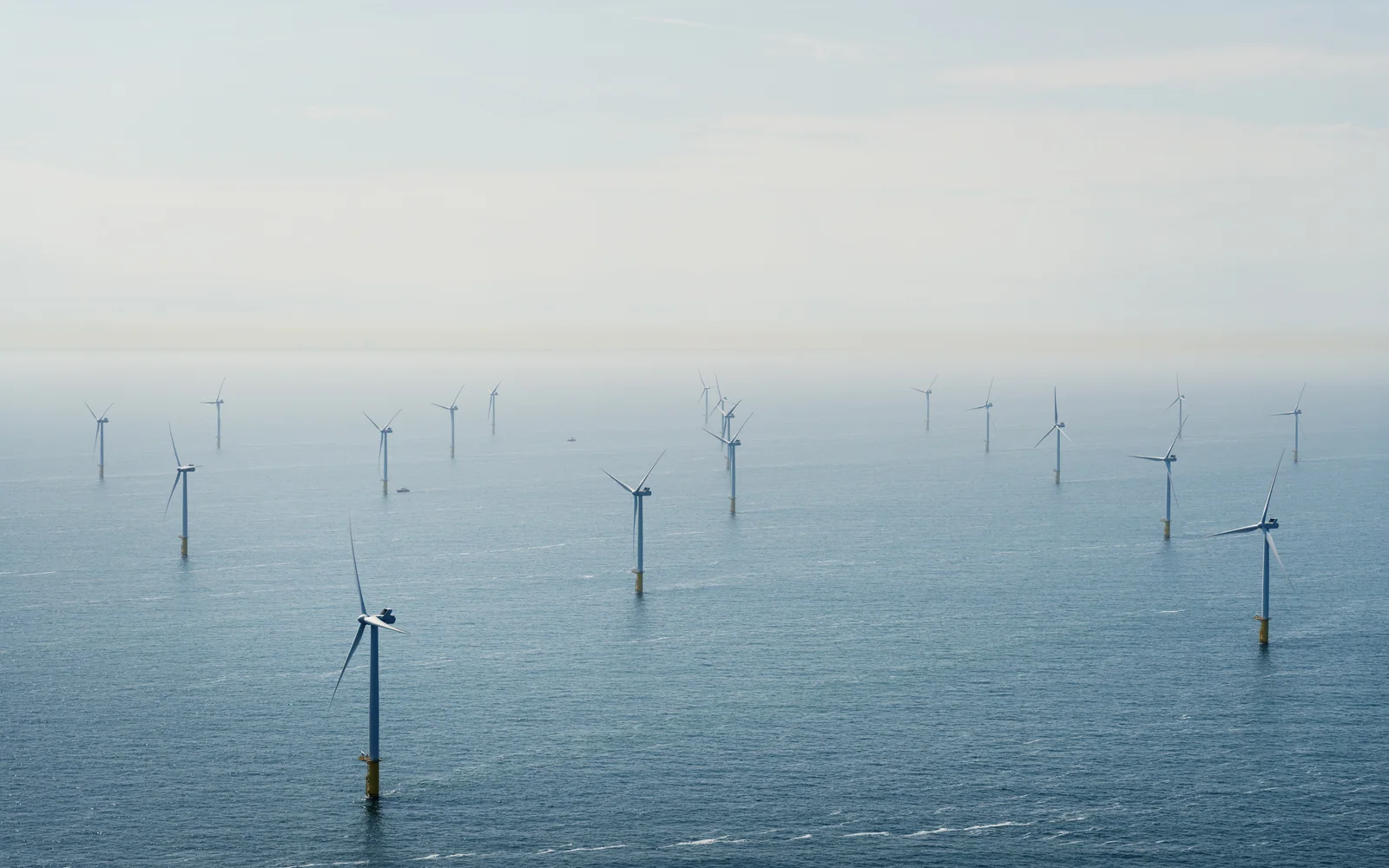
Thirty miles east of Montauk, in water most Long Islanders will never see, there is now a wind turbine standing where there was nothing. It went up in April. Eighty-three more are supposed to follow.
Sunrise Wind is the largest offshore wind project in New York, and after several years in which almost everything about American offshore wind was contested, delayed or halted, it has quietly become a construction project rather than a controversy. It is worth taking stock of what has actually been built, because the political noise around this industry has not tracked the steel particularly well.
The specifications
The project is rated 924 megawatts, enough to power close to 600,000 homes. It sits roughly 30 miles off Montauk Point and comes ashore through an approved transmission route that connects to the state's electricity grid at the Holbrook Substation, in the Town of Brookhaven.
The array will consist of 84 Siemens Gamesa SG 11.0-200 DD turbines. Eleven megawatts apiece, with a rotor diameter of 200 meters, which is a class of machine that did not exist commercially when this project was first proposed.
Where construction actually stands
Onshore work is nearly complete. Offshore work is well underway. Turbine installation began earlier this year and the first turbine was installed in April, a milestone the industry treats as the real dividing line between a project on paper and a project in the water. By the spring the project was approaching the halfway mark overall, with several major construction scopes already finished.
Full commercial operation is expected in the second half of 2027. That is later than some of the early estimates, which had first power arriving in 2026. The slip is not mysterious. Construction was stopped for a period by a federal stop-work order, and resumed only after a court ruling permitted the work to continue.
It is a fair thing to note about a project of this scale that it was halted by one branch of government and restarted by another, and is now roughly half built. Both facts belong in the same paragraph.
What Suffolk County gets
This is the part that makes it a business story rather than an energy story.
The construction phase supports more than 800 direct jobs, with a stated investment of $700 million in Suffolk County alone, plus the indirect and induced work that follows any project of that size. Construction employment is real money and it is also temporary, which is the usual and correct caveat.
The durable piece is the Northeast Operations and Maintenance Hub, which the developer is putting in the Town of Brookhaven. It will support roughly 100 permanent full-time positions over the 30-plus year life of the projects, and it is not scoped only to Sunrise Wind. It is intended to service an entire national portfolio of offshore wind projects from Long Island.
A hundred jobs is a modest number next to the thousand a single fulfillment center would bring. It is also a different kind of number. Operations and maintenance work on offshore turbines is technical, well paid, tied to a physical location that cannot be moved, and guaranteed by contract for three decades. Very little on Long Island comes with that combination.
The infrastructure question underneath it
Sunrise Wind arrives at a moment when Long Island's grid is suddenly the subject of an argument. Brookhaven has just imposed an 18-month moratorium on data centers, in part over a single proposal that would draw up to 176.6 megawatts, and the state has paused hyperscale data center permitting statewide while it works out who pays for grid capacity.
Those two stories are the same story seen from opposite ends. One is 924 megawatts of new supply landing in Holbrook. The other is a queue of very large new loads asking to plug in nearby. The Town of Brookhaven happens to be where both arrive.
Whether that is fortunate timing or merely coincident timing depends on things not yet decided, chiefly how the state resolves the cost of connecting large new loads to a grid that ratepayers also use. But it does make the geography striking. The substation that will take the output of New York's largest offshore wind farm sits a short drive from the parcel where a $1 billion data center wants to consume a fifth of it.
Loading comments…