
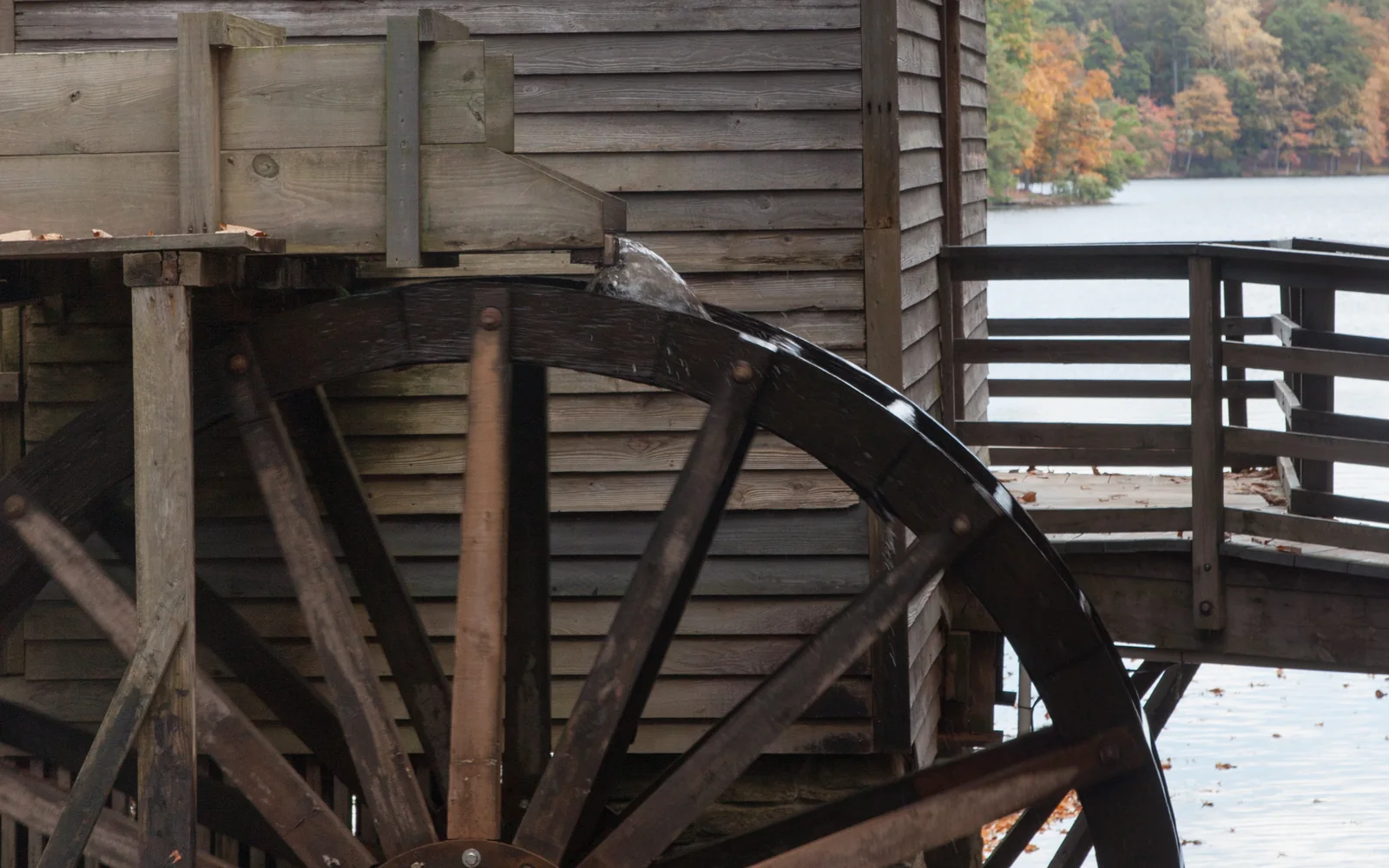
If you drive Old Northern Boulevard at the head of Hempstead Harbor, something has changed in the last few weeks. The small dark building by the water has walls again.
On July 14 the Roslyn Landmark Society reported that siding on the west side of the Roslyn Grist Mill is finished, the window framing is complete, and work has moved to the north wall. Only the east side is left. For a structure that has been closed, jacked into the air and wrapped in construction for most of a decade, the siding going on is the moment it stops looking like a project and starts looking like a building.
A mill older than the county
The story usually starts in 1698, when John Robeson was granted permission to put a mill at the head of Hempstead Harbor. That date is worth handling carefully, because it is a permission, not a building. The structure standing on Old Northern today is later: the Roslyn Landmark Society dates it to between 1715 and 1741, and Preservation Long Island puts it at about 1720. Local signage tends to collapse the two and hand you a mill thirty years older than it is.
What makes it matter is how it was built. The mill is a Dutch-framed watermill, put together with Old World framing methods that no longer survive in Europe itself. That makes it one of the last Dutch-type mills anywhere in the United States, and by one description the oldest surviving Dutch commercial structure in the country.
It was not a curiosity when it was new. It worked as a water mill for more than 150 years, grinding grain into flour that shipped out to New York and the West Indies. Roslyn was a port, the harbor was a working waterfront, and this building was industry.
A tea room, then fifty years of nothing
By the twentieth century the milling was long over. In 1916 and 1917 the building was restored as a museum of industrial arts. From 1920 until 1974 it ran as a tea house and tourist attraction, which is how most people over a certain age in Roslyn know it, usually secondhand, through a parent or a grandparent who ate there.
It has been closed to the public since 1974. It went on the National Register of Historic Places in 1986 and then kept deteriorating anyway. Nassau County owns it, the Roslyn Landmark Society manages it, and for decades the obstacle was not money alone but the absence of any clear plan for what the building would be if it were saved. There were false starts across more than ten years.
Lifting a building off the ground
Actual work started in November 2018. In January 2020 the entire structure was raised eight feet into the air so that a new foundation could be built underneath it and the timber frame could be repaired using traditional methods rather than modern shortcuts. The new foundation was finished in November 2021, and the mill was then set back down at street level for the first time in more than a century.
In February 2025 the last rafters went in and the project held a topping-off ceremony. Everything since has been the skin: roof, then windows and doors, then trim through June of this year, and now the siding.
What it cost, and who paid
Roughly $3.1 million was raised between 2015 and 2020, from New York State, Nassau County, and a mix of trusts and foundations. More than $2 million in additional grants followed between 2023 and 2025.
The most recent piece is a $2 million Nassau County capital award paid in two installments, the second of which was delivered on April 24, 2026. It is earmarked for exactly what is happening now: siding, windows and doors, plus the structural and accessibility work that has to be finished before anyone can be let inside.
That accessibility line is the unglamorous reason a restoration like this takes eight years. Reopening a three-hundred-year-old mill to the public is not only a question of making it look right. It has to be enterable, and an eighteenth century industrial building was not designed with that in mind.
When you can go in
The expectation is 2027. That would be the first time the public has been inside in more than fifty years.
Until then it is a building to look at from the sidewalk, and the Landmark Society's stated goal for the exterior is that it will reflect how the mill appeared when it was first built at the start of the eighteenth century. Given that the alternative, for most of living memory, was a derelict shell nobody could enter and nobody could really see either, a wall of new siding on Old Northern Boulevard is a genuine event.
Nassau County keeps most of its history as plaques on poles. The farms are subdivisions, the mills are parking lots, and the marker tells you what used to be there. The Roslyn Grist Mill is one of the rare cases where the actual object is still standing, and it is still standing because a village society and a county spent eight years and seven figures putting it back together board by board.
Loading comments…