
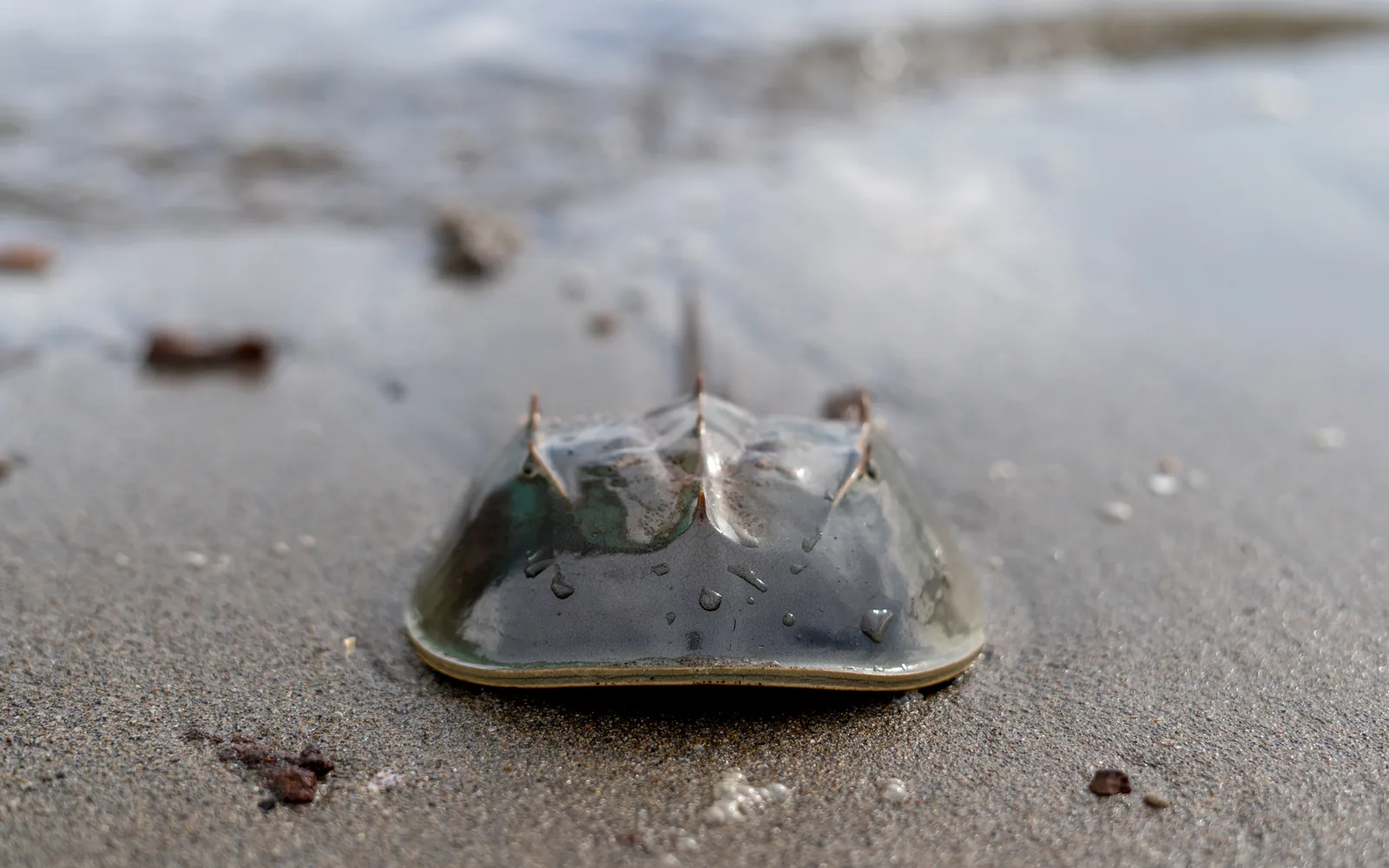
If you have walked a Long Island bay beach on a warm night around a full moon in late May, you have probably seen it: dozens of dark, helmet-shaped shells pushed up into the wash, moving with the deliberation of something that has been doing this for a very long time. Fewer people see it now than did thirty years ago. New York has just decided to do something about that, on a timeline that ends in 2029.
What the law actually does
Governor Kathy Hochul signed the Horseshoe Crab Protection Act in December 2025. It phases out the taking of horseshoe crabs from New York State waters, and the New York State Department of Environmental Conservation is explicit about the endpoint: all take of horseshoe crabs from state waters becomes prohibited on January 1, 2029.
It does not arrive all at once. The permitted harvest steps down each year first, roughly a quarter at a time, giving the commercial fishery a few seasons to adjust before the number reaches zero.
Two details make this law unusual. It covers both uses, bait and biomedical, rather than carving out the pharmaceutical industry. And it is a legislature setting a marine harvest to zero by statute, which is not how New York normally manages a fishery.
Why it took two tries
A version of this bill reached the governor's desk a year earlier and was vetoed. The stated reasoning was that managing a marine species is better handled by the fisheries scientists at DEC than by legislation, and that a hard ban would land on commercial fishermen and on the biomedical sector.
Both objections are real, and the version that got signed answers them with time rather than exemptions. The phase-down is the compromise: nobody's business closes overnight, and the crabs still get the ban. Assemblywoman Deborah Glick, one of the bill's sponsors, described it in about those terms, as a decent compromise that gives the industry room to transition.
The animal in question
Horseshoe crabs are not crabs. They are closer relatives of spiders and scorpions, and their basic body plan has been recognizable in the fossil record for hundreds of millions of years, which is why they are routinely called living fossils. Hochul used the phrase herself in describing them as a vital keystone species for New York.
"Keystone" is doing real work in that sentence. It is not a compliment about how interesting they are. It means other things fall over without them.
Why medicine wanted them
Horseshoe crab blood is blue, because it carries copper rather than iron, and it contains cells that clot violently in the presence of bacterial endotoxin. In the 1970s that reaction was turned into a test called Limulus amebocyte lysate, or LAL, and LAL became the global standard for confirming that an injectable drug, a vaccine or an implanted device is not contaminated.
If you have ever had a shot, the safety of that shot was almost certainly verified using a reagent derived from this animal. It is one of the stranger debts modern medicine owes to a bay-bottom invertebrate.
The reason a ban is now thinkable is that the chemistry has moved on. A synthetic alternative, recombinant factor C, reproduces the same detection without the animal, and it has been working its way into pharmaceutical quality standards for years. New York's law effectively pushes the last holdouts toward it.
The birds that eat the eggs
The conservation argument, though, is mostly about a shorebird.
Red knots are federally protected birds that fly one of the longest migrations of any animal, and they do it by refueling almost entirely on horseshoe crab eggs at a handful of Atlantic stopovers. A red knot arrives on the coast underweight and has a narrow window to nearly double its body mass before continuing north. Crab eggs are the only food source dense enough and abundant enough to do that on schedule.
When horseshoe crab numbers crashed in Delaware Bay in the 1990s, red knot numbers followed. That sequence is the single clearest reason states along this coast have moved, one after another, to restrict the harvest. New Jersey did it in 2008. Connecticut in 2023. New York's law now covers the middle of that stretch, which matters for a migratory animal that does not care about state lines.
What has been happening on Long Island
The local trend is what made this urgent rather than theoretical. Research by the Maritime Aquarium documented the Long Island Sound horseshoe crab population declining somewhere between 2 and 9 percent a year. Compounded over a couple of decades, even the low end of that range is a very different Sound.
Long Island's geography is central to the whole question. Horseshoe crabs need shallow, sheltered, sandy shoreline to spawn, and the Island is essentially a long series of exactly that: the Great South Bay, the Peconics, the bays behind the barrier beaches, the north shore harbors. New York's protections are not an abstraction here. They are mostly about beaches you can drive to.
Some protection already existed before the new law. DEC closes all commercial horseshoe crab harvest during periods around the full and new moons in May and June, precisely because that is when the animals come ashore to spawn and are at their most gatherable. The new statute takes that logic to its conclusion.
How to actually see them
Spawning peaks in late May and June, on the high tides that come with the new and full moons, mostly after dark. Bring a flashlight, walk a bay beach at high water on those nights, and you will find them at the tide line, the smaller males clamped onto the larger females.
Volunteer spawning surveys run on Long Island beaches during those windows and are among the easier pieces of real field science to join, which is a better way to spend a June evening than most.
One thing worth knowing
If you find a horseshoe crab stranded upside down, flip it over. They come ashore on a high tide, sometimes get turned by the surf, and cannot right themselves. A crab left inverted in the sun does not survive the afternoon.
Pick it up by the edges of the shell with both hands. Never by the tail. The tail is what it uses to right itself and it breaks, which converts a rescue into a slower version of the same problem.
Long Island has spent the last few years watching what happens when a piece of its own natural inheritance is pushed to the edge and then, occasionally, hauled back. The Blue Point oyster is one version of that story. The horseshoe crab is a slower one. They have been coming up onto these beaches since long before there were beaches here to come up onto, and as of December they have until 2029 before the harvesting stops entirely.
Loading comments…