
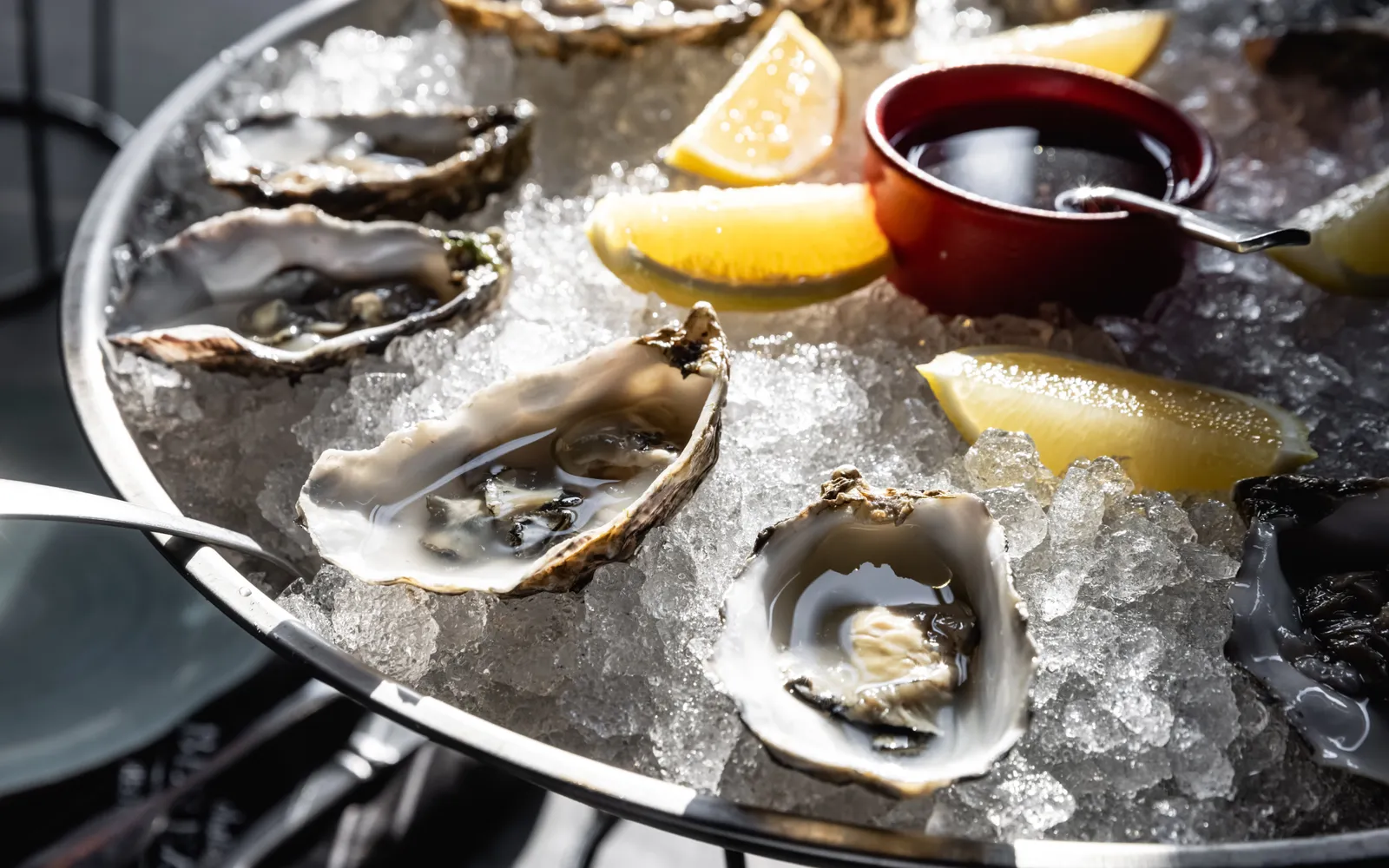
Order a dozen oysters almost anywhere in the country and there is a good chance one variety on the list carries a Long Island name: the Blue Point. Few foods are so completely tied to a single stretch of local water, and few local industries have risen, collapsed, and clawed their way back quite like Long Island's oyster trade. The briny half-shell on your ice is, in a very real sense, a taste of Suffolk County history.
A name born on the Great South Bay
The Blue Point takes its name from Blue Point, a hamlet on the Great South Bay in the Town of Brookhaven. The name was coined in the early 1800s, and by the middle of that century "Blue Point" had become one of the most recognized words in American seafood, shorthand for a clean, balanced, medium-brine oyster pulled from the bay's rich bottom.
The name mattered so much, in fact, that New York moved to protect it by law. In 1908 the State Legislature made it illegal to sell or label any oyster as a "Blue Point" unless it had been cultivated in the waters of the Great South Bay in Suffolk County. It was an early, and unusually specific, piece of food-origin protection, a hint of just how valuable Long Island's oyster reputation had become.
When Long Island helped feed a national oyster craze
It is hard to overstate how oyster-crazed 19th-century America was, and Long Island sat near the center of it. Great South Bay beds supplied a hungry New York City market and shipped far beyond it, and the Blue Point's fame traveled with the name. By legend the variety even reached the tables of European royalty, the kind of story that only attaches itself to a food people genuinely prized.
For decades, baymen worked the shallow waters off the South Shore, and oystering was a livelihood woven into the identity of towns up and down the bay. Then, within a single generation, it nearly disappeared.
The collapse
The decline came from several directions at once. Worsening water quality and pollution around 1910 made it increasingly difficult for oyster seed to take hold. Then the weather finished what the water started: a major coastal storm in 1931 and the catastrophic hurricane of 1938 devastated the beds and the businesses that depended on them. Later decades brought their own blows, including the brown tide algal blooms that clouded Long Island's bays and hammered shellfish. By the late 20th century, the once mighty Great South Bay oyster fishery was a shadow of its former self.
The comeback, one lease at a time
The modern chapter is a quieter, more deliberate revival, and much of it is playing out on the East End. Under New York's Environmental Conservation Law, the state ceded rights to certain underwater lands of Peconic Bay and Gardiners Bay to Suffolk County for the purpose of shellfish cultivation. The result is the county's Shellfish Aquaculture Lease Program, which lets growers lease parcels of bay bottom to farm oysters and clams, encouraging private investment and a new generation of local shellfish businesses.
The program has become a working engine of Long Island's oyster renaissance, and it is very much active: in 2026 the state and county opened a five-year review of the lease program and its cultivation-zone map, a sign that demand for bay bottom keeps growing. On the Great South Bay itself, growers are once again farming the historic waters that gave the Blue Point its name.
There is an environmental payoff, too. A single oyster can filter tens of gallons of water a day, pulling nitrogen and particulates from the bays as it grows. Every leased acre of oysters is, in effect, a small water-treatment plant working around the clock, which is why shellfish farming has become a favorite of both foodies and clean-water advocates on Long Island.
Tasting the revival
All of this lands, eventually, on the raw bars of Nassau and Suffolk, where local oysters from the Peconics and the South Shore now share the ice with their famous namesake. Slurping a Long Island oyster in late summer is a small, delicious way to connect with a story that runs back two centuries: the bays that made the region famous, the collapse that nearly erased the trade, and the farmers slowly bringing it back one lease at a time.
So the next time a Blue Point shows up on a menu, remember it is not just an oyster. It is a Long Island original, and after a very long low tide, it is finally on the rise again.
Loading comments…