
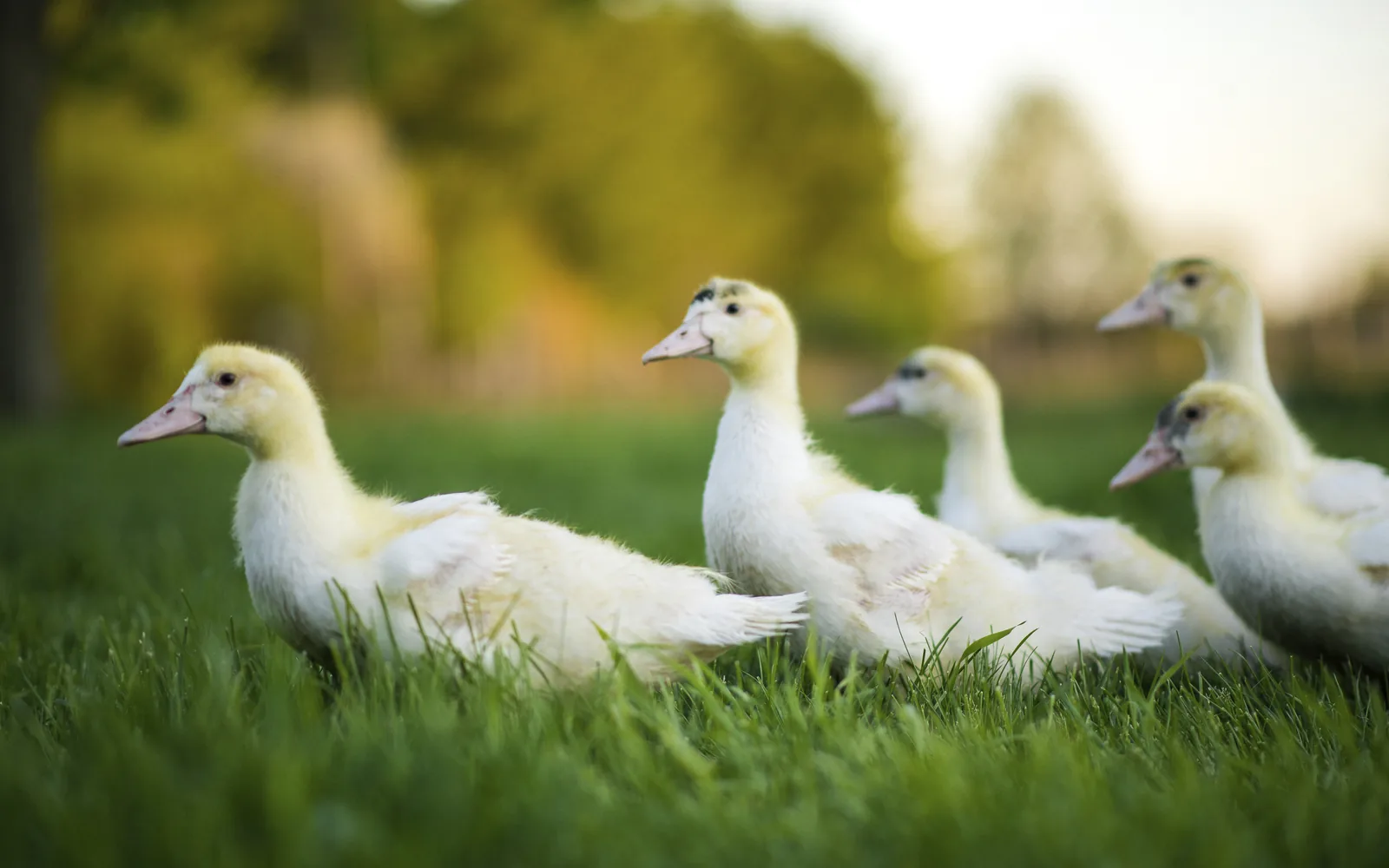
There is a phrase that still appears on menus from Manhattan to Los Angeles: Long Island duck. It reads like a regional description, the way Blue Point reads for oysters or Idaho reads for potatoes. For most of the last century it was also literally true. Today it rests almost entirely on one farm in Aquebogue, and eighteen months ago that farm lost every bird it had.
How Long Island became duck country
Crescent Duck Farm was founded in 1908 by the great-grandfather of its current owner, Doug Corwin. It was not unusual then. It was typical. By the early 1960s Long Island supported more than 100 duck farms, and together they produced roughly two-thirds of all the duck eaten in the United States.
The white Pekin duck, brought to the United States from China in the 1870s, found in Suffolk County almost perfect conditions: sandy soil, abundant fresh water, mild coastal winters and a very large hungry city an hour to the west. Duck farming became part of the East End's identity in the same way potatoes and, later, wine grapes did.
Then it went away. Not in a single collapse but in a long grind of property taxes, utility costs, and the expense of meeting water-pollution rules on farms that had been discharging into creeks for generations. Some owners sold to developers, at prices that made the arithmetic easy. Others simply closed. Thirty years ago there were about 40 duck farms left near Crescent. Then a dozen. Then, for the better part of a decade, one.
January 2025
Corwin found the problem on a routine barn inspection. Within days, Crescent had become another line in the global H5N1 avian influenza outbreak that has affected roughly 175 million birds across all fifty states since 2022.
The response to a confirmed detection is not negotiable. The entire flock, about 100,000 birds, was destroyed. Nearly the whole workforce was laid off. A business that had processed roughly a million ducks a year, supplying an estimated four percent of the nation's duck meat and a long list of high-end restaurants, went to zero.
What made it worse than a normal catastrophic loss was what the birds represented. Crescent's flock was not generic livestock you reorder from a supplier. It carried a proprietary bloodline the family had selectively bred over generations, developed for the specific characteristics chefs bought the farm's ducks for. You cannot buy that back. You can only rebuild it, and only if some of it survives.
Fifteen thousand eggs
Some of it survived. State officials permitted the farm to spare roughly 15,000 eggs from the winter culling after they tested negative for the virus. Those eggs were raised in quarantine for months, which is a sentence that undersells the tension involved: the entire genetic future of Long Island duck farming sat in isolation, waiting on test results.
The USDA's Animal and Plant Health Inspection Service lifted the quarantine on May 12 after 500 samples taken across 20 barns all came back negative. At the end of that month, the first wave of about 900 grown ducks came back to Aquebogue. Another 900 followed a week later, then another.
By the following stage of the rebuild the farm had roughly 1,500 females and 600 males at 24 weeks, old enough to lay. Crescent projected harvesting around 1,100 eggs a day over a six-to-seven-week window, enough to produce a commercially viable second generation and enough to begin bringing staff back.
What that means for your table this fall
Crescent works through distributors rather than selling direct at scale, which is why home cooks rarely see the name. Its ducks reach kitchens through operations like Baldor, Pat LaFrieda, Chefs' Warehouse and D'Artagnan. The farm has been targeting a return to restaurant and foodservice distribution through 2026, with its signature ducks back to market around this fall.
If you eat out on Long Island this autumn and see duck on a menu with the farm named, that is the comeback. It is worth ordering, and worth asking about.
The argument Corwin keeps making
Through all of it, the farm's owner has pushed a single policy point: American poultry producers need access to vaccination against avian influenza. The United States has generally barred poultry vaccination, largely because vaccinated flocks complicate trade certification with countries that will not accept birds from vaccinating nations. The cost of that policy falls on producers like Crescent, who have no defense except biosecurity and luck.
His position is blunt and easy to understand: a second outbreak would end the farm. Long Island lost a hundred duck farms to economics over half a century. It would be a strange ending to lose the last one to a virus we have a vaccine for.
Why it matters beyond dinner
Long Island keeps losing the things that made it a place rather than a suburb. The duck farms went. The Blue Point oyster nearly went, and is only now clawing back. The potato fields became vineyards, which was a good trade, and then some of the vineyards became houses, which was not.
A single farm in Aquebogue is not going to reverse any of that. But there is something worth noticing in a family that spent a hundred and eighteen years building a bloodline, lost all of it in a week, and started over with fifteen thousand eggs. Long Island duck is still a real thing, and this year it is a closer call than most people realize.
Loading comments…