
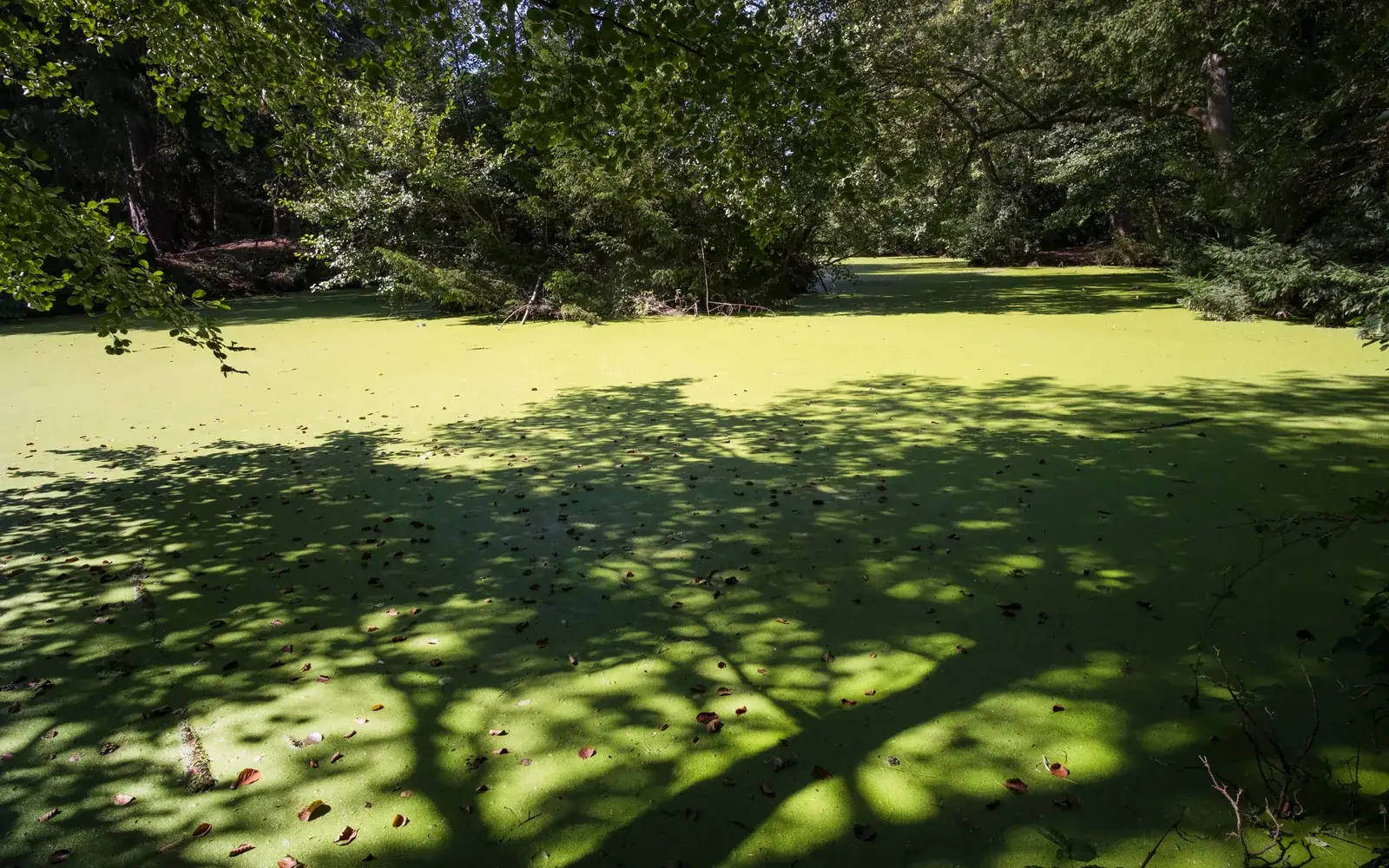
The warning does not come with tape across the path or a padlock on a gate. It comes as a sentence from the county asking you, please, not to go in.
The Suffolk County Department of Health Services has confirmed new cyanobacteria blooms at two East End water bodies: Silver Brook Pond in Flanders and Pond Lane Pond in East Hampton. The confirmation came from surface water samples analyzed by Stony Brook Southampton. Health officials are asking residents not to use those waters, and to keep children and pets away from the area.
Cyanobacteria is more commonly called blue-green algae, which is a slightly misleading nickname twice over. It is not really an alga, and it is frequently not blue.
What you are looking at
Blue-green algae live in Long Island's lakes and streams all the time, in small enough numbers that nobody notices them. What changes in late summer is the arithmetic. Warm, still, nutrient-loaded water lets them multiply until they are the dominant thing in the pond, and that is a bloom.
The county's own description of what to look for is the useful part, because the popular image of a bloom, a solid green mat, is only one of its forms. Blooms show up in shades of green, blue-green, yellow, brown or red. They can form floating scums on the surface. They can also make the water look like paint has been stirred into it, which is the tell people most often miss because it does not look like anything organic at all.
The rule the county gives is simple and it is the one to carry to every freshwater pond on the Island for the rest of the summer: if the water looks scummy or discolored, stay out of it. You are not expected to identify the species from the shoreline. You are expected to not swim in something that looks wrong.
Why the dog is the one in danger
Blue-green algae can produce toxins, and the exposure that matters most on Long Island is rarely the swimmer. It is the retriever.
A person who wades into a discolored pond usually notices, gets uncomfortable and gets out. A dog drinks the water, swims through the scum, then spends the next twenty minutes licking its own coat clean. That is a concentrated dose delivered to a much smaller body, and it is the reason state and county health guidance keeps putting pets in the same sentence as children.
If contact does happen, rinse off with clean water immediately. The county advises seeking medical attention if any of the following follow exposure: nausea, vomiting or diarrhea; irritation of the skin, eyes or throat; allergic reactions; or difficulty breathing.
How to report one
Which number to call depends on the water body, which is a small piece of Long Island bureaucracy worth knowing before you are standing next to something green.
If the pond or lake contains a Suffolk County-permitted bathing beach, contact the Department of Health Services' Office of Ecology at 631-852-5760 between 8:30 a.m. and 4:30 p.m., or email [email protected].
If it does not, the report goes to the New York State Department of Environmental Conservation instead, at [email protected].
The state also maintains NYHABS, a public map of every affected fresh water body in New York, which is the fastest way to check a specific pond before you drive to it.
The part that is not really about algae
Two ponds is a small headline. The pattern behind it is not.
Blooms feed on nutrients, and on Long Island the nutrient story is the same one that runs underneath almost every water question out here: what is in the groundwater, what runs off the lawns, and what a very heavy rain moves in a hurry. The Island's drainage problem and its water quality problem are not separate problems. They are the same water, taking the same route, at speed.
The advisories are seasonal and they lift. The conditions that produce them arrive earlier and stay later than they used to. For now the instruction is the simple one, and it applies well beyond Flanders and East Hampton: look at the water before you let anyone into it, and if it looks like paint, it is not a swimming day.
Loading comments…