
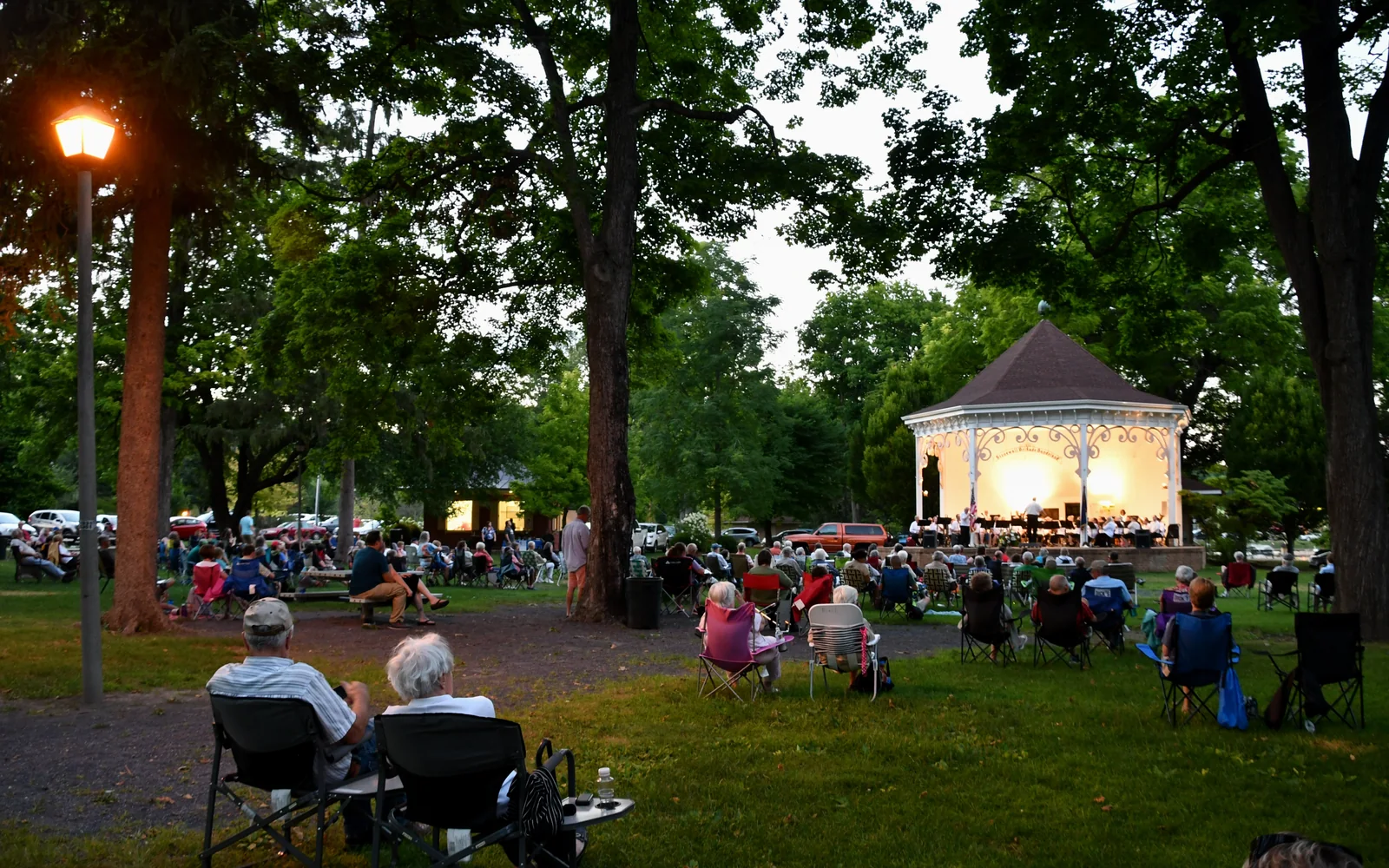
Seven hundred and twenty nine thousand dollars for streetscapes, signage and the Village Green. That is the first line item on Farmingdale's share of New York's downtown money, and it is a fair summary of what these programs actually are. Downtown revitalization, on the invoice, is sidewalks and lamp posts and better signs.
On May 15, 2026 the state announced 11 projects on Long Island across two programs. The Village of Farmingdale received $4.5 million through NY Forward. The Village of Hempstead received $10 million through the Downtown Revitalization Initiative. Add the $4.5 million Lindenhurst won in an earlier round and three Long Island villages are now working through roughly $19 million in state-directed downtown spending.
Two programs, sized to the downtown
The Downtown Revitalization Initiative is the larger of the two, a $10 million award aimed at downtowns with the scale to absorb it. NY Forward is the $4.5 million version, built for smaller village centers that would drown in a ten million dollar plan.
Both work the same way, and the sequence matters if you want to follow the money. The award is announced first. A local planning committee then works up a strategic investment plan and picks the projects. Only after that does anyone know what is being built. So a village can be a winner for a year before there is anything to look at.
Farmingdale bet most of it on one building
Farmingdale's four projects use the full $4.5 million:
$3,000,000 to build a new performing arts center downtown
$729,000 to upgrade streetscapes, signage and the Village Green
$564,000 to improve pedestrian safety on Fulton Street
$207,000 for a small project fund
Two thirds of the award into a single building is an unusual allocation, and it is a genuine bet. Farmingdale already fixed the hard part of its downtown problem: the restaurants came, the apartments went up near the station, and Main Street is busy. What it does not have is a reason for people to still be there at nine o'clock on a Tuesday. A theater is an attempt to buy one.
Hempstead spread its ten million across seven
The Village of Hempstead's list runs to $9.7 million of its $10 million award:
$3,495,000 for Main Street streetscape and pedestrian improvements
$1,900,000 for infill mixed-use development at 257 Main Street
$1,250,000 for a workforce center in the Hempstead Bank Building at 54 Main Street
$1,100,000 for a pedestrian plaza at Helen Keller Way
$880,000 for transit-oriented development and a greenway at Block 39
$600,000 for a small project grant program
$475,000 for an innovation hub at 150 Bedell Street
Three of those seven are specific buildings at specific addresses rather than general categories, which is a useful signal. A plan that names 54 Main Street has already done the work of finding a building and an owner. A plan that says "facade improvements" has not.
Lindenhurst is two years ahead
Lindenhurst won its $4.5 million on May 17, 2024, in NY Forward's first round, alongside Long Beach and a $9.7 million DRI award for Huntington Station. Its seven projects:
$2,300,000 to expand Village Square, enlarging the public space and adding a bandshell
$765,000 for pedestrian streetscapes on Hoffman and Wellwood
$639,000 to create the Lindenhurst Greenway linking Village Park to the LIRR station
$322,000 to upgrade the facade at 101 to 109 North Wellwood
$300,000 for a small project fund
$90,000 to renovate the BACCA Arts Center building
$84,000 to improve storefronts at 197 to 201 South Wellwood
Lindenhurst is the one to watch, precisely because it is older. Its list tells you what happens between the press release and the concrete, which is the part of this process nobody covers.
The string attached is housing
Both Farmingdale and Hempstead were certified under the state's Pro-Housing Communities program in order to qualify for the money. That is not a footnote. It is the actual mechanism.
The state is not simply handing out downtown grants. It is handing them to municipalities that have committed to plan for housing, and it has made that commitment a gate rather than a preference. On an island where zoning is the local blood sport and multifamily proposals go to war at the village board, that is a meaningful lever, and it is being pulled quietly. A village that will not plan for housing is not on the list.
What to actually watch
Three things, in order of how fast you will see them.
The small project funds are the money that reaches individual business owners: $600,000 in Hempstead, $300,000 in Lindenhurst, $207,000 in Farmingdale. Facade and storefront grants are the least glamorous items on any of these lists and reliably the most visible change per dollar spent, because a block of repaired storefronts reads as a recovering downtown long before anything structural finishes.
The streetscape lines are the largest and the slowest. Hempstead's $3.5 million of Main Street work will close lanes and irritate everyone for a season before it improves anything.
And the buildings, the theater and the workforce center and the innovation hub, are the ones that will still be under discussion in three years. An announcement is not a groundbreaking, and on Long Island the distance between the two is usually measured in years, not months.
None of this is the kind of investment that makes a good ribbon cutting photograph. It is sidewalk width, crossing distance, storefront glass and where the benches go. Those are also the specific things that decide whether people walk a downtown or drive through it, which is the only question any of these villages is actually trying to answer.
Loading comments…