
Every business has a pile of bills it does not really read. The card processing statement, the bank's monthly analysis, the freight invoices, the software renewal. Somebody approves them, files them, and moves on, because the alternative is spending a week with a calculator on charges that are supposed to be what they are. A Long Island company is betting that is exactly where the money is, and that an AI can find it in the time it takes to make coffee.
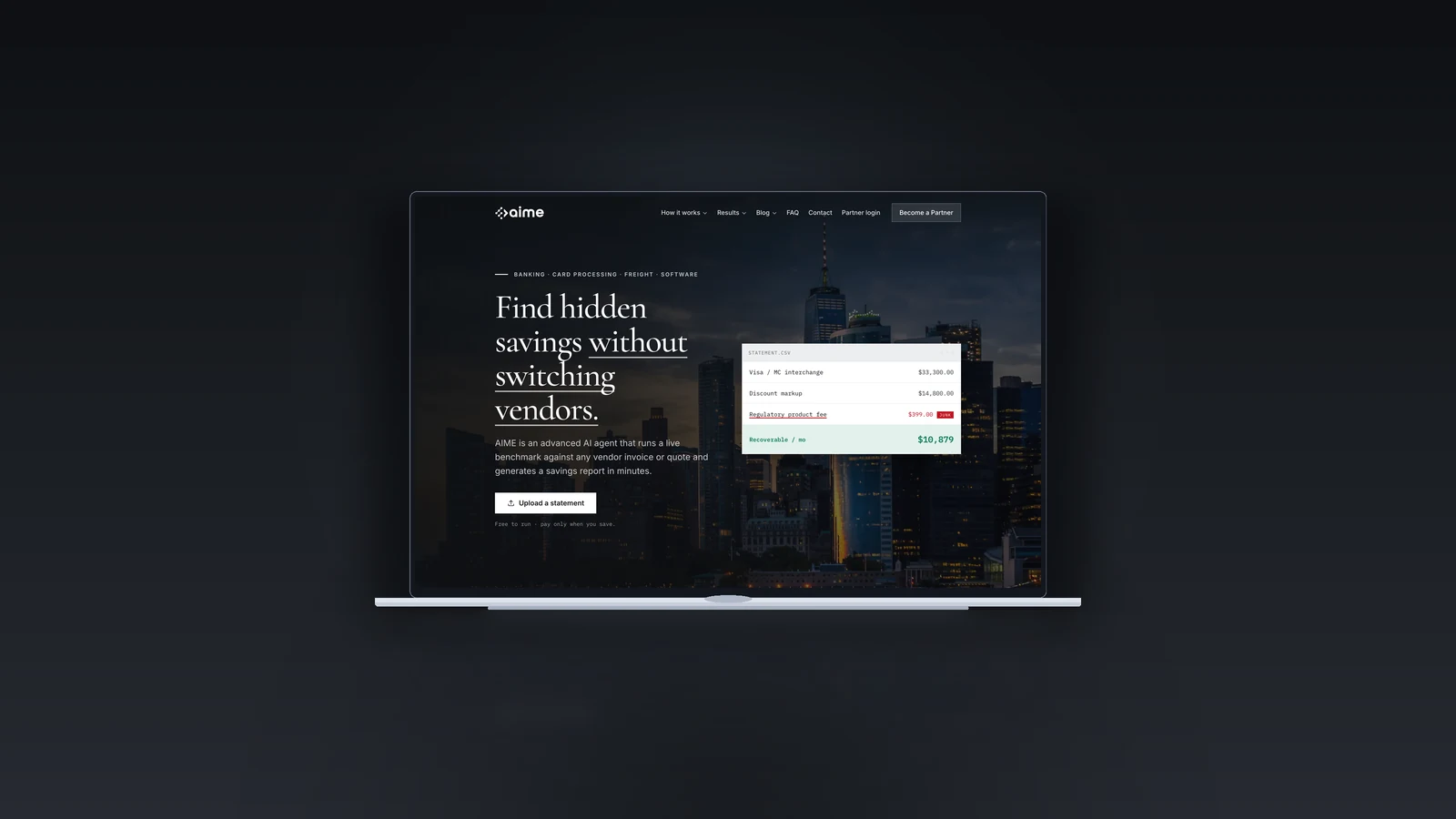
The company is AIME, and the product is an AI agent that reads a vendor invoice, benchmarks every line on it against what that line should cost, and hands back a report of what looks wrong. It works on bank fees, card processing, freight and small parcel, enterprise software licensing, insurance, payroll, energy, and the unglamorous end of the ledger like janitorial supply and linen. You can try it on the company's own site without talking to anybody first.
The problem is not the big number. It is the small ones.
The pitch rests on a claim any business owner recognizes once it is said out loud: a vendor contract does not protect your price. It protects your vendor's forecast. Rates drift up through the term, a tenth of a percent here, a new regulatory product fee there, and none of it arrives as a letter you have to sign. It arrives as a slightly larger number on a statement nobody was going to read line by line anyway.
AIME's own figures put up to 20 percent of controllable spend as lost to that drift, and say the team behind it has monitored more than $100 billion in vendor spend across banking, cards, freight and software. Those are the company's numbers, not independently audited ones, and they are the scale it is arguing from rather than a promise about your statement.
What makes it a Long Island story is who it describes. The businesses most exposed to quiet fee creep are not the ones with a treasury department. They are the restaurant group running four locations, the medical practice with a dozen providers, the distributor shipping every day, the retailer whose card volume tripled since 2019 without anybody renegotiating anything. That is most of the business community here, and none of it has a person whose job is reading the processor's statement. The company has published its own breakdowns of the first two of those cases, on what restaurants actually pay to take a card and on the payment fees that turn up in medical and dental practices.
What it actually does
The workflow is three steps and the company is direct about the fact that none of them require you to change anything. You upload statements in whatever format you have them, PDF, spreadsheet, CSV, plain text or a photograph of a page, anywhere from 30 days to 36 months of history and up to 50,000 pages. AIME reads them, builds a line-item view, and benchmarks each charge against market rates, flagging markups, erroneous surcharges and the fees that exist mainly because somebody stopped asking.
Then it produces a report written to be handed to the vendor, with an AIME consultant available to sit in on that conversation. The company says reports come back in minutes rather than the days or weeks a traditional audit takes, and that monitoring continues afterward, so a rate that gets quietly restored later is caught the next month instead of three years later. Its own case for that, on why a fee audit has to be a subscription rather than an event, is the clearest statement of the reasoning.
You can run one yourself, today
The part worth knowing about is that the live tool is on the home page at hiaime.com. Drop in a statement, or load one of the sample files if you would rather not upload anything real, and tell it what you want out of the report: organize this by fee category, audit these merchant services, look at this bank depository analysis, check this parcel invoice. It runs and shows you the line items with the flagged charges called out.
That is an unusual thing for a company in this business to put in public. The traditional version of a fee audit is a consultant, a signed engagement, and a report in two weeks. Putting the engine on the home page and letting anyone run a sample through it is a product announcement and a dare at the same time.
What it costs
Nothing up front, which is the model this corner of the industry has always used and is the reason it is worth a look even if you are skeptical. No retainer, no hourly billing, no cost to run the audit. The company is paid a share of what it actually recovers, and its own documentation puts that share at 35 to 50 percent of realized savings against a standard 12-month term of continuous monitoring. If it finds nothing, you pay nothing, which puts the risk of the whole exercise on the company rather than on you.
Nothing gets switched, and nothing gets connected
Two things here matter more to a small business than the savings number, and the company leads with both. You do not change vendors. The audit happens inside the relationships you already have, so there is no migration, no downtime, no IT project and no awkward conversation with a bank you otherwise like.
And AIME does not connect to your systems. No API integration, no access to your customer data, no card data. It reads the statements you hand it and nothing else, which the company points out keeps the whole exercise outside the GDPR, CCPA and SOC questions that make anything touching customer records a six-week procurement discussion. For a business without an IT department, that is the difference between trying this and never getting round to it.
Why this is landing now
The timing is not an accident. Visa and Mastercard reached a roughly $38 billion settlement with merchants over swipe fees that would trim interchange by a tenth of a percentage point and hold rates at or below their end-of-2023 level for five years. More than 90 percent of the merchants covered are small businesses, and court approval is expected late this year or early next.
Here is the part that gets lost in the coverage, and it is the useful thing to understand before your processor sends you a letter about it. Interchange is the networks' share. It is one set of lines on your statement. The markup your processor adds on top of it, the monthly fees, the PCI charges, the batch and statement fees and the assorted items with names invented by a marketing department, are not part of that settlement at all. A tenth of a point off interchange is real money at volume, and it is entirely possible to receive that reduction in one column while a markup climbs in the next one. Which is precisely the gap an audit is for.
The other half: a marketplace for the people who already know your books
AIME also runs a partner program, and on Long Island that is arguably the more interesting half. The pitch to consultants, brokers and industry specialists is that they bring the audit to businesses they already advise and earn recurring income from every introduction where AIME finds savings, month after month rather than once. Partners get what the company calls the Backoffice, which scans statements and produces the analyses, and partners who know a particular industry contribute that knowledge back into the system and draw on what other partners have taught it.
That describes a lot of people here. The Island is thick with bookkeepers, fractional CFOs, insurance brokers and IT consultants who already sit across the desk from owners looking at exactly these statements. Details are at hiaime.com/#partners.
The honest summary
AIME is a small company, a handful of people by its own LinkedIn listing, making a large claim: that an AI can do in minutes what an auditing firm charges a retainer and two weeks for, and that most businesses are leaving real money on the table because nobody has time to look. Every figure on its site is its own, and none of it has been independently verified here.
But the underlying observation does not depend on the technology being as good as advertised. Most Long Island businesses genuinely have not audited a vendor statement in years, the fees genuinely do drift, and an audit that costs nothing unless it finds something is a rare thing to be offered. At worst you learn your statements are clean, which is worth knowing too. The tool is at hiaime.com.
Loading comments…