
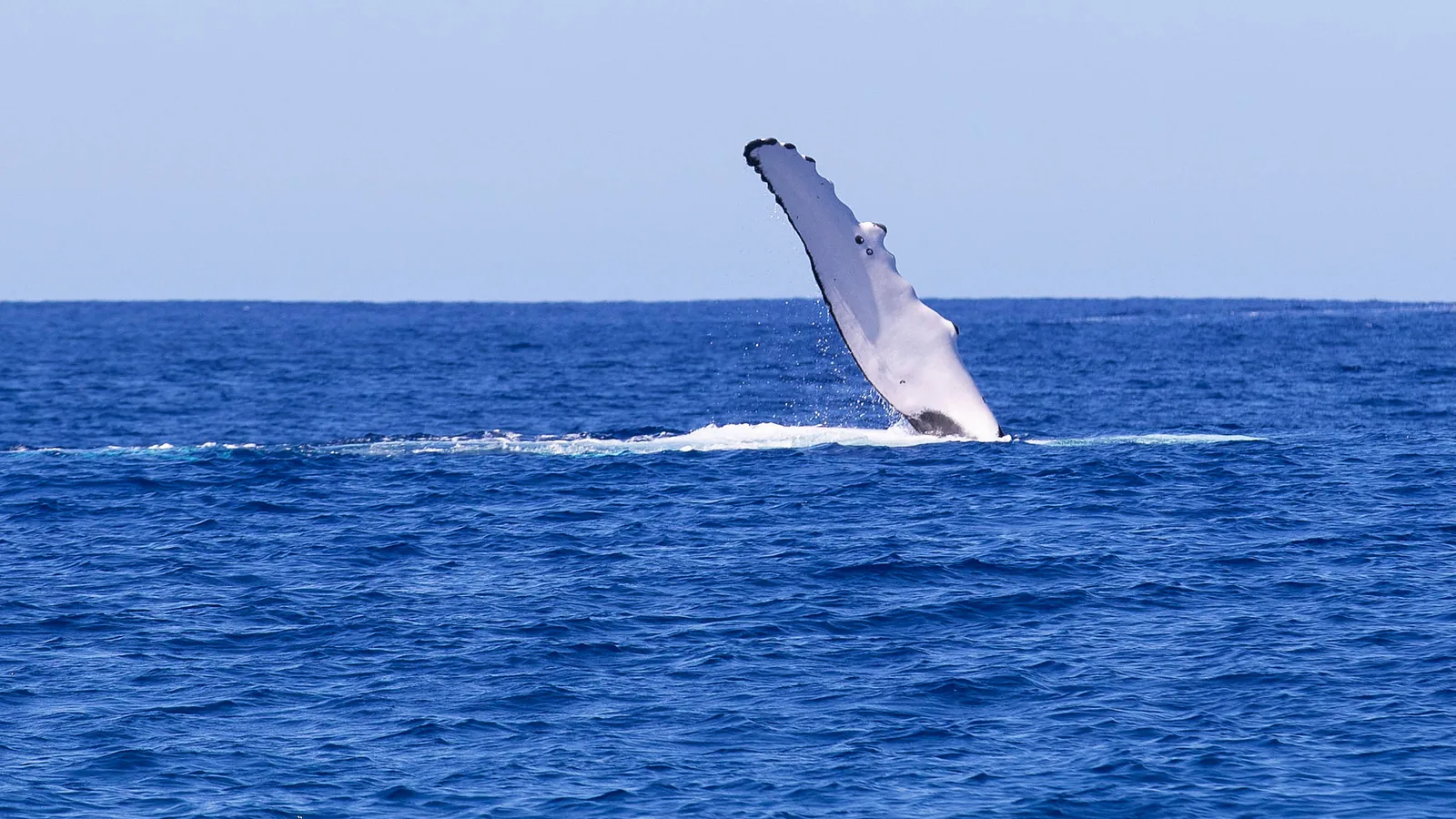
New York State's boating safety course is about to gain a new subject: how not to hit a whale. Governor Kathy Hochul on Monday signed the Whale Awareness Act, now Chapter 208 of the laws of 2026, a bill that orders the state to build whale avoidance guidance and push it to the people most likely to need it, which on Long Island means nearly everyone with a boat registration.
What the law actually does
The act directs the Department of Environmental Conservation to develop recommendations and educational materials for reducing collisions between vessels and marine mammals, working with the Port Authority, the United States Coast Guard, the National Oceanic and Atmospheric Administration and the federal Marine Mammal Commission.
Those materials travel down three pipes. They get posted publicly and distributed to party and charter boat operators, the fishing and whale watching fleets that spend the most hours where whales feed. They get folded into every boating safety course certified by the state parks office, so the curriculum itself now includes marine mammals. And beginning December 31, 2028, the Department of Motor Vehicles will hand the guidance to vessel registrants in nine downstate counties, Suffolk and Nassau first among them, along with the five boroughs, Westchester and Rockland.
The core provisions take effect 180 days after the signing, which puts the DEC's homework due in early February 2027.
The quiet mechanism: Brianna's Law built the classroom
The clever part of this law is not the content, it is the delivery. Since January 1, 2025, under Brianna's Law, every operator of a motorized vessel in New York, regardless of age, has needed a boating safety certificate. That earlier law built a classroom that every Long Island boater must eventually pass through. The Whale Awareness Act simply adds a lesson to it.
That means no new enforcement, no new fines and no speed zones. This is an education statute. But it reaches a population no voluntary outreach campaign ever could: all of it.
Why New York needed this
The waters off Long Island have become one of the busiest overlaps of whales and boat traffic on the East Coast. NOAA has tracked an unusual mortality event among Atlantic humpback whales since 2016. The tally stands at 268 dead humpbacks from Maine to Florida, and 50 of them were found in or just off New York. Of the carcasses that scientists were able to examine, roughly 45 percent showed evidence of vessel strike or entanglement.
The bill's sponsor memo points to one stretch that concentrated minds in Albany: between December 2023 and February 2024, twenty-three dead whales were reported along the coast, twelve of them off New York and New Jersey. Behind the humpback numbers sits a grimmer one, the North Atlantic right whale, with fewer than 350 individuals remaining, for which a single vessel strike is a measurable fraction of the species.
The whales are not passing through by accident. Humpbacks now feed close enough to Long Island's ocean beaches to be seen from the sand, following the schools of menhaden that have rebounded in New York waters. More whales closer to shore, plus the summer boat traffic that pours out of the South Shore inlets, is the collision math the law is trying to change.
An Albany rarity: nobody voted no
The bill was sponsored by Assemblymember Rebecca Kassay of Port Jefferson, whose district watches this play out from the North Shore, and by Senator Pete Harckham. It passed the Assembly on February 24 and the Senate on March 5 by a vote of 59 to 0, then waited five months for the governor's pen. It was delivered to her desk on August 7 and signed three days later.
The sponsor memo also makes an economic argument that lands differently on Long Island than it might upstate: whale protection supports the state's growing marine tourism business, and a whale strike is expensive for the boat as well as the whale.
What changes for you
If you already hold your safety certificate, nothing happens tomorrow. The DEC's materials are due within six months, the course content follows, and the DMV mailings to Suffolk and Nassau boat owners start at the end of 2028. Federal rules that already require keeping distance from whales remain exactly as they are.
What the law really changes is the default. Until now, learning how to behave around a 40-ton animal off Fire Island was something a boater had to go looking for. Starting with the next generation of safety certificates, it will be something every Long Island boater was taught.
Loading comments…