
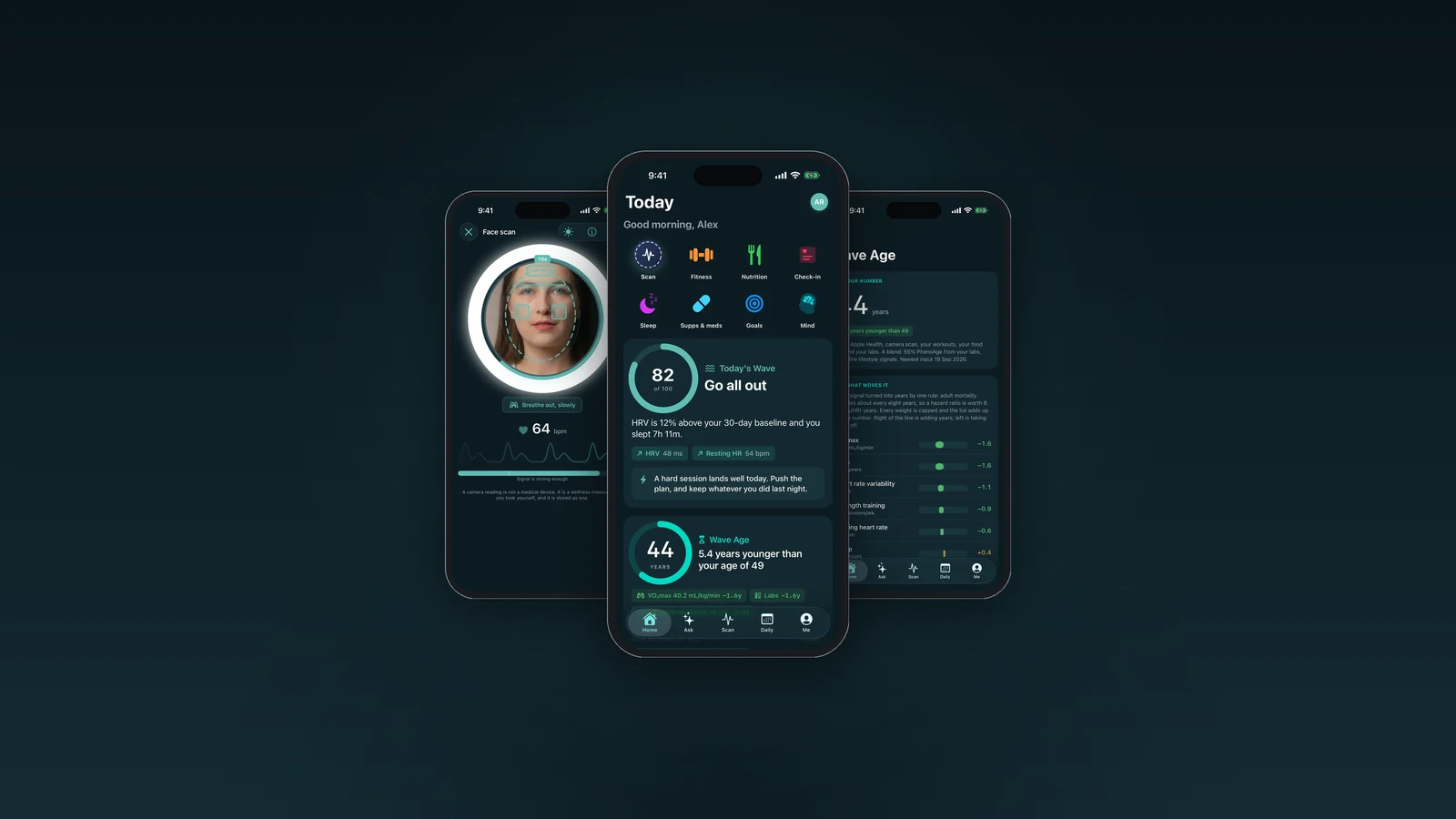
Somewhere on your wrist or your nightstand is a device that knows exactly how you slept last night. In a different app is the run you did on Tuesday. In a kitchen drawer, folded twice, is the result sheet your doctor's office printed after your last blood draw. None of the three has ever met the other two, and nothing you own has ever told you what all of it means together. A studio on the Route 110 corridor in Melville has spent the past year building the layer that does, and it opens to the public in October.
Wave Wellness is a general wellness app built by Wave Agency, the Melville marketing, media and technology firm that has been shipping software from Long Island since 2001 and that also publishes this title. It reads sleep, movement, food, recovery and mood together, from the wearable you already own and from a forty second look at your phone's front camera, and hands back one number each morning with a plain sentence explaining why it moved. It is free. It is in private testing now, and at launch it arrives on iPhone, Apple Watch, iPad, Android and the web at the same time.
The pitch behind it is simple. Most people already have a watch telling them one thing, a sleep app telling them another, a lab report in a folder nobody has opened since the day it arrived, and a notebook of what they lifted. Four sources, no conversation between them. Every one of them can draw a chart, and not one of them can say whether today is a good day to train hard. "That is not a data problem," the company says. "Everybody already has the data. It is a translation problem."
Where it started
The idea came out of the gap between a training log and a doctor's office. The data to know when to push, when to recover and what was changing already existed, on a wrist and in a lab report, and nothing read it together. Wave Wellness was built to close that gap, and it was designed with physician input from the start.
Wave Wellness is built by Wave Agency, and the approach behind it is patent pending.
The medical case for it is about catching things early. People already carry the signals on their wrists and in their bloodwork; what they lack is a way to read them together, every day, and to walk into an appointment with that picture already in hand.
Two minutes, and one number
The app opens on a screen called Today, and the design argument of the whole product is visible in about four seconds. At the top is a ring with a score from 0 to 100 in it and a verdict beside it in plain words: go all out, hold steady, or take it easy. Under that is the reason, written as a sentence rather than drawn as a graph. In the demo week the company publishes, it reads: HRV is 12 percent above your 30-day baseline and you slept 7 hours 11 minutes. Two chips carry the raw figures behind that claim, 48 milliseconds of heart rate variability and a resting heart rate of 54, and below them sits one line telling you what to actually do with it.
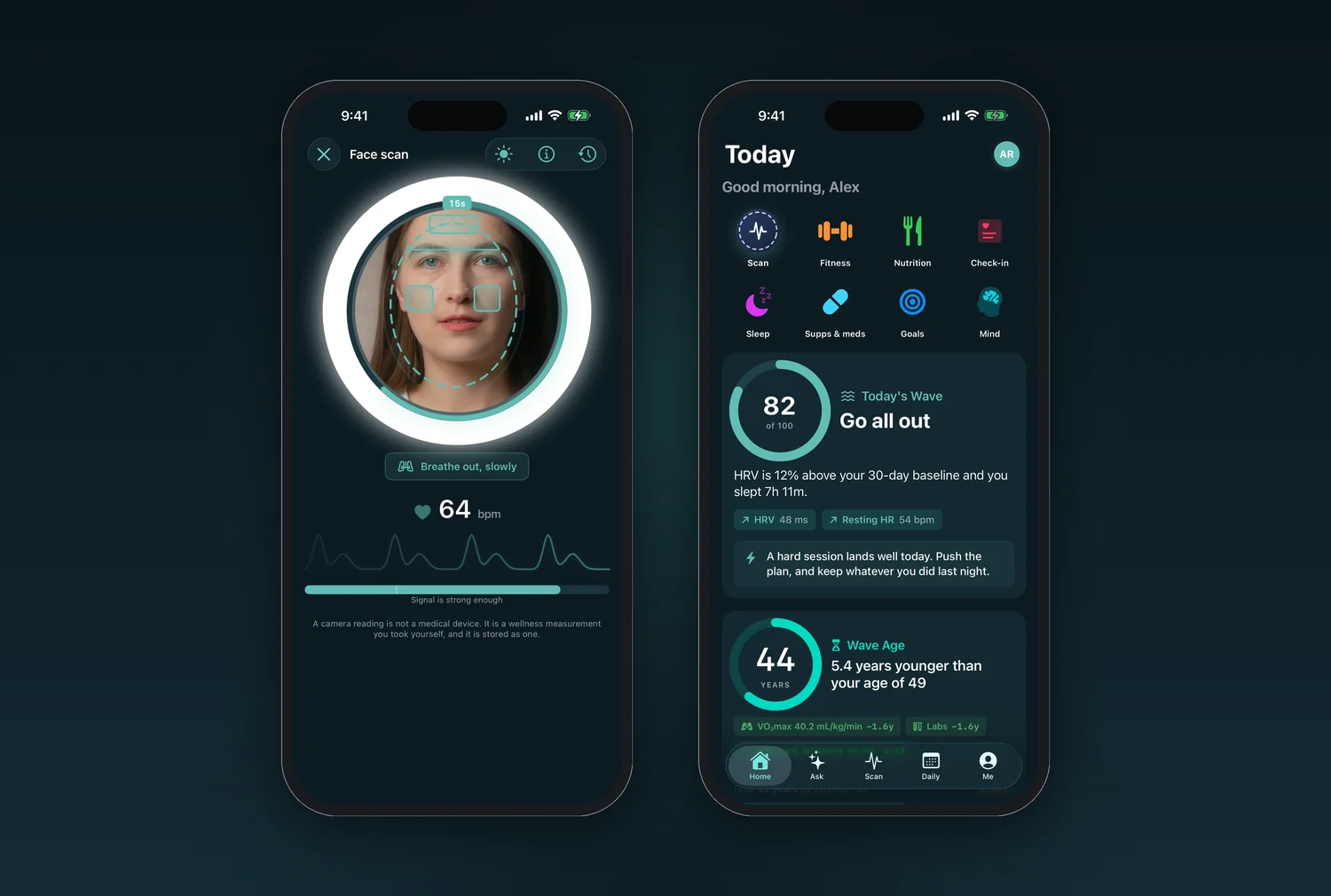
Above the ring is a row of eight shortcuts covering everything the app tracks: scan, fitness, nutrition, check-in, sleep, supplements and medications, goals and mind. Below it is a second ring carrying a number the app calls your Wave Age, and after that the day's insight. The check-in is five questions about sleep, food, movement and how you actually feel, answered in a row in about ten seconds, and it is what turns the streak and feeds the mood line the insights read.
The company is blunt about why the score sits on top of everything else. "A number on its own is a horoscope. Every wellness app on earth can show you HRV 48 and readiness 71, and none of that tells a person standing in their kitchen at seven in the morning what to do. So the rule we wrote first was that no figure appears in this app without the reason next to it. If we cannot say why it moved, we do not get to show it."
The part people will talk about: a camera that reads your pulse
The feature that will get Wave Wellness noticed is the one that requires nothing but the phone already in your hand. Sit still, look at the front camera for forty seconds, and the app reads your vitals off your face.
The physics is real and not new: every heartbeat pushes blood into the skin and changes its color by a fraction far too small for any eye to catch. The app averages the forehead and both cheeks thirty times a second, separates that pulse from the ambient light and from your own small movements, and reads six figures off the trace. Heart rate. Heart rate variability three ways, reported as RMSSD, SDNN and pNN50. Breathing rate, which is pulled from the way slow breathing sways the entire pulse signal. Breath response, meaning how far the heart rate rises and falls with each slow breath, which the company describes as the steadiest figure a camera can produce because the breath timing is known. And signal quality, shown live while you scan and stored with the reading forever.
During the scan the screen turns into a lamp, throwing a white ring of light onto your face, because in most kitchens at seven in the morning the phone is the only decent light source there is. A pacer prompts you to breathe in for five and out for five, which is six breaths a minute, the rate at which heart rate variability is conventionally measured. If you wear an Apple Watch and have granted Health access, the watch's own heart rate from the same minute is shown next to the camera's, which is an unusually confident thing for a company to put on screen.
The honesty is the interesting part. Every number is stored with the share of the recording that carried a clean pulse, so a poor reading is labeled as one rather than quietly filed as fact. The heart rate variability figures are gated hardest of anything the scan reports, and are withheld rather than guessed when the signal is short. The company's own page says a chest strap is far more precise than any camera and that nothing the scan reports is a diagnosis, and puts a line to that effect on the scan screen itself.
"A camera in a kitchen is a wellness measurement and we store it as one, which is exactly what it says on the screen while you are taking it," the company said. "What the scan is genuinely good at is being the same measurement every single morning, because there is nothing to charge, nothing to strap on and nothing to remember. A slightly less precise reading you will actually take every day beats a perfect one you take four times a year."
The same camera has a second job, once a week. A SmileScan takes two photos of the teeth and gums and reads what changed against the user's own baseline, area by area, in plain words. Body scans are coming soon.
A second age, and the arithmetic behind it
The number Wave Agency has clearly built the app around is Wave Age: one biological age assembled from bloodwork and behavior, sitting in a ring on the home screen with a goal line under it. In the published demo record it reads 44 against a chronological age of 49.
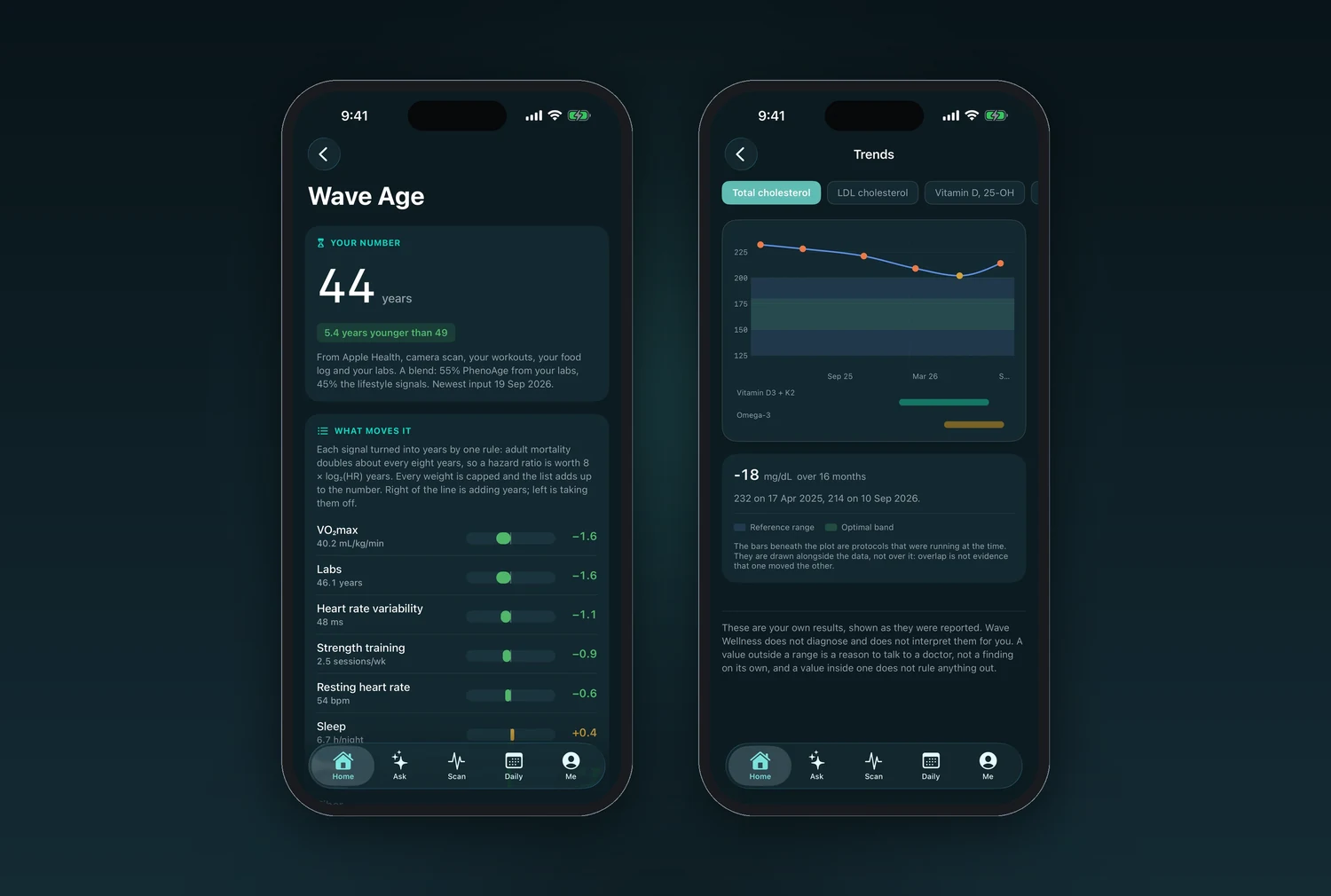
Fifty five percent of the blend comes from PhenoAge, the nine-marker model published by Morgan Levine in 2018 and fitted on national mortality follow-up data. The remaining forty five percent comes from behavior, and the app names the study behind each weight on the screen where the weight is applied: resting heart rate (Jensen, 2013), cardiorespiratory fitness measured as VO2max (Kodama, 2009), daily steps against a reference of 7,500 (Paluch, 2022), sleep duration (Cappuccio, 2010), strength training at one to two sessions a week (Momma, 2022), and protein and fiber at 25 to 29 grams a day (Reynolds, 2019).
Three rules govern it, and they are more interesting than the number. Nothing is substituted for a missing marker: the model wants nine blood values, and a panel missing even one returns no lab age at all and instead names what is missing so you can ask for it on the next draw. The arithmetic is stated rather than hidden, resting on one published assumption, that adult mortality risk roughly doubles every eight years, which is what lets a hazard ratio be converted into years. And every year is attributed, by re-running the whole model with a single input moved to the middle of its healthy range and reporting the difference. When the app says sleep is costing you four tenths of a year, that is a real counterfactual rather than a slice of a pie invented to make a chart add up.
"Refusing to produce a number is a feature, and it was the hardest thing to hold the line on," the company said. "With eight of the nine markers we could give you an age that looks exactly like a real one. It would be wrong and you would have no way of knowing. So the model says no, and tells you what to add to your next blood draw. A longevity score you cannot interrogate is a horoscope with a hazard ratio stapled to it."
Your bloodwork, off the sheet your lab actually sent
The Wave Age lab model only works if the labs get in, and this is where the app does something most consumer wellness products refuse to attempt. You photograph the result sheet. Not a tidy PDF exported from a portal, although that works too, but a phone picture of a printed page, or a scanned fax with no text layer in it at all.
The page is read as a page rather than flattened into text first, and there is a good reason for that: some labs mark a value abnormal by which column it is printed in, and column position is the first thing text extraction throws away. What comes back is every value with its unit and its reference range, ready to chart.
Then it stops. Every extracted value lands in a queue as unconfirmed, sitting beside the document it came from, and waits for you. You keep it or you discard it, and one tap keeps a whole report. A number nobody has looked at is never plotted, never counted toward your Wave Age and never quoted back to you. The live marker catalog runs to 52 lab markers, and the trends screen charts each one over time against both the lab's reference range and an optimal band, with any supplement or protocol that was running at the time drawn as a bar alongside the plot rather than over it, under a note pointing out that overlap is not evidence one moved the other.
"The review queue is the difference between a tool and a liability," the company said. "A model reading a lab report is genuinely useful. A model deciding what goes into your permanent health record is not, and I do not care how good the confidence score is. A human being confirms every value in this app before it is allowed to become a dot on a chart. That is not a limitation we are apologizing for. It is the product."
The coach, and the things it will not say
Underneath all of it is what the company calls the layer of intelligence, and its job is to learn what normal looks like for you specifically rather than for a population. Every scan, night, workout, meal and lab teaches it your own baseline, and each morning it reads the day against that and makes one call with the reason attached.
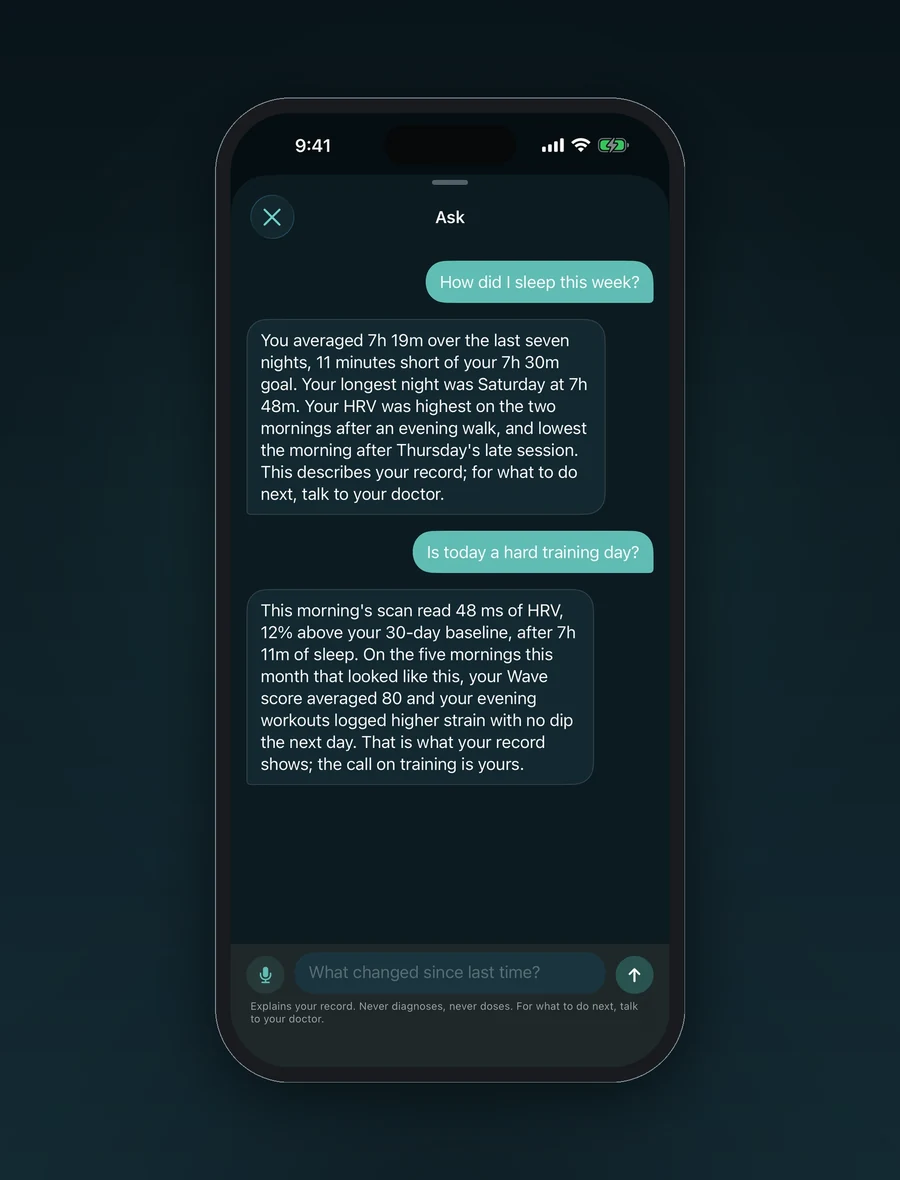
There is a chat surface called Ask, and its boundaries are drawn tightly. It answers from your confirmed results and your device data and from nothing else. It explains and describes, and it never diagnoses and never doses. Asked whether today is a hard training day, the published example does not answer the question: it lays out what this morning's scan read, what the last five comparable mornings looked like, and then says the call on training is yours. No transcript is kept. The thread lives only on the page in front of you, which the company describes as a deliberate choice rather than a missing feature, on the grounds that a stored conversation becomes a second place health information accumulates with its own retention and its own export obligation.
The other half is correlation. The app writes down connections in plain English across everything it holds, of the kind that are obvious in hindsight and invisible in practice: you sleep 34 minutes longer on days you walk after dinner. There is a recap on Sundays with one small thing to try. And where the record is thin, it says so: under a week of readings it gives a range rather than a verdict, and on a morning with nothing in it, the app stays quiet rather than making a confident call built on yesterday.
Sleep, food, mood, and the pill you forgot to take
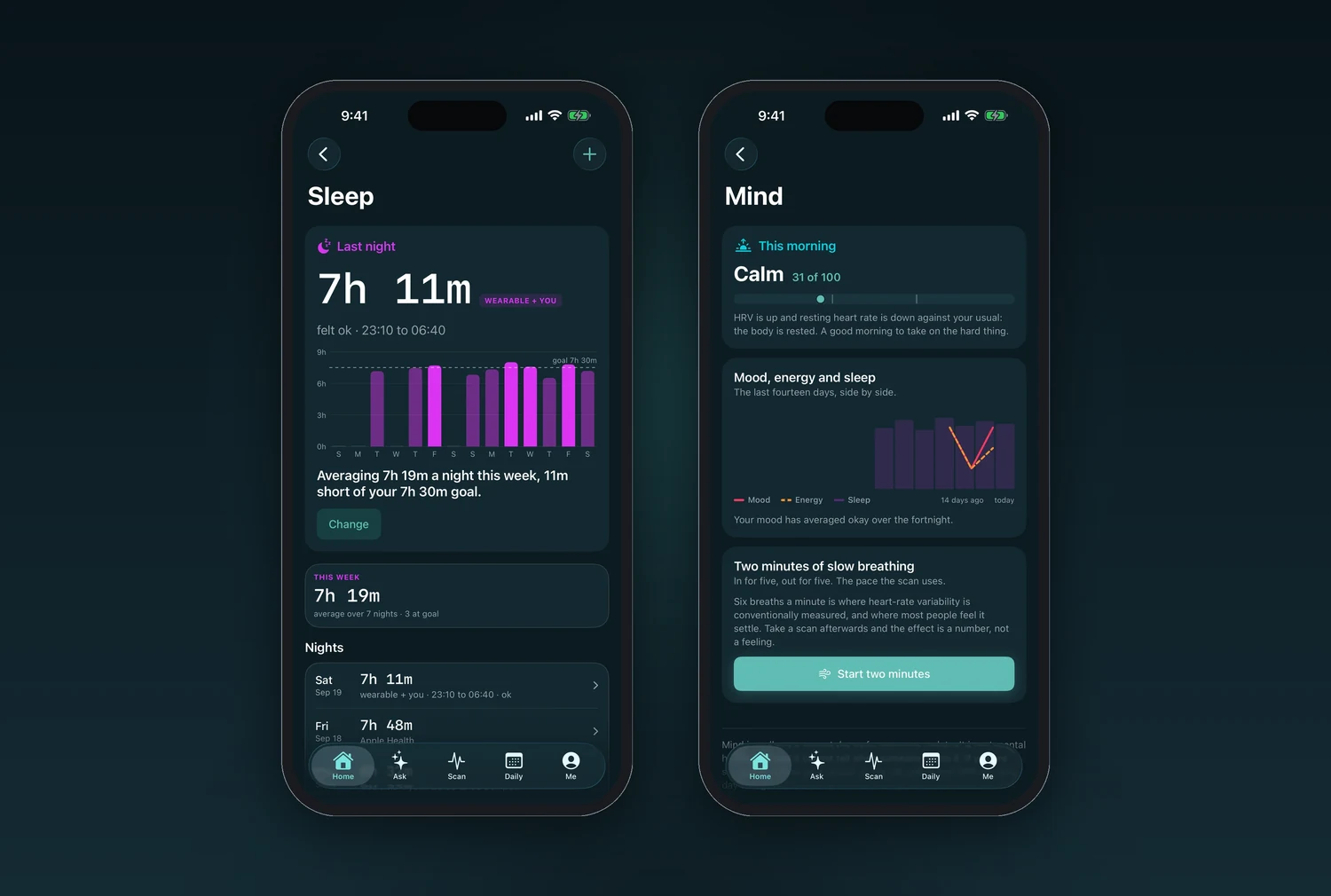
The rest of the record is built to be filled in without homework. Sleep shows last night, the fortnight behind it and a dotted goal line across the bars, and labels each night by where it came from, whether that is the wearable, you, or both. Nutrition takes a photograph, a barcode or a tap on a recent meal, and tracks protein, fiber, water and caffeine rather than asking anyone to maintain a spreadsheet of macros they will abandon by Thursday. Mind carries a calm reading, mood and energy plotted against the same fourteen nights of sleep, and a two minute paced breathing exercise at the same six breaths a minute the scan uses, with the pointed suggestion that you take a scan afterwards so the effect is a number rather than a feeling.
Supplements and medications are laid out by time of day, with four weeks of whether each one was actually taken and whether the markers it is meant to move have moved. That adherence view is quietly the most useful thing in the app for anyone on a protocol, because the most common reason a regimen is not working is that it is not being followed, and it is the one variable almost nothing else can see. Goals can be set on Wave Age, weight, sleep, steps or workouts a week, and removing a goal keeps every reading and deletes only the target.
What it connects to, and what it does not pretend to
Two sources are live today. On iPhone the app reads Apple Health directly, which covers the Apple Watch and any ring or band that already writes to Health, authorized once on the handset with no account to connect. And there is a direct connection to WHOOP, pulling recovery, strain, sleep stages, heart rate variability and resting heart rate each morning. WHOOP has no step counter, and the app says so on the card rather than showing a zero, which is a small detail that tells you something about how the rest of it is built.
That Apple Health route already carries Oura and Garmin on iPhone: whatever their apps write to Health, from sleep and heart rate to workouts, reaches Wave today, though their own scores, such as Oura's Readiness and Garmin's Body Battery, stay in their apps. Health Connect on Android, Fitbit, and direct Oura and Garmin connections are all described as being wired now, each with its own status on its own card. Fitbit is built and waiting on Google to approve the account that reads health scopes. No wearable is required at all: the phone counts steps, the check-ins and meals work on their own, and the face scan supplies a resting heart rate for anyone who wears nothing.
Every screen you own, all at once
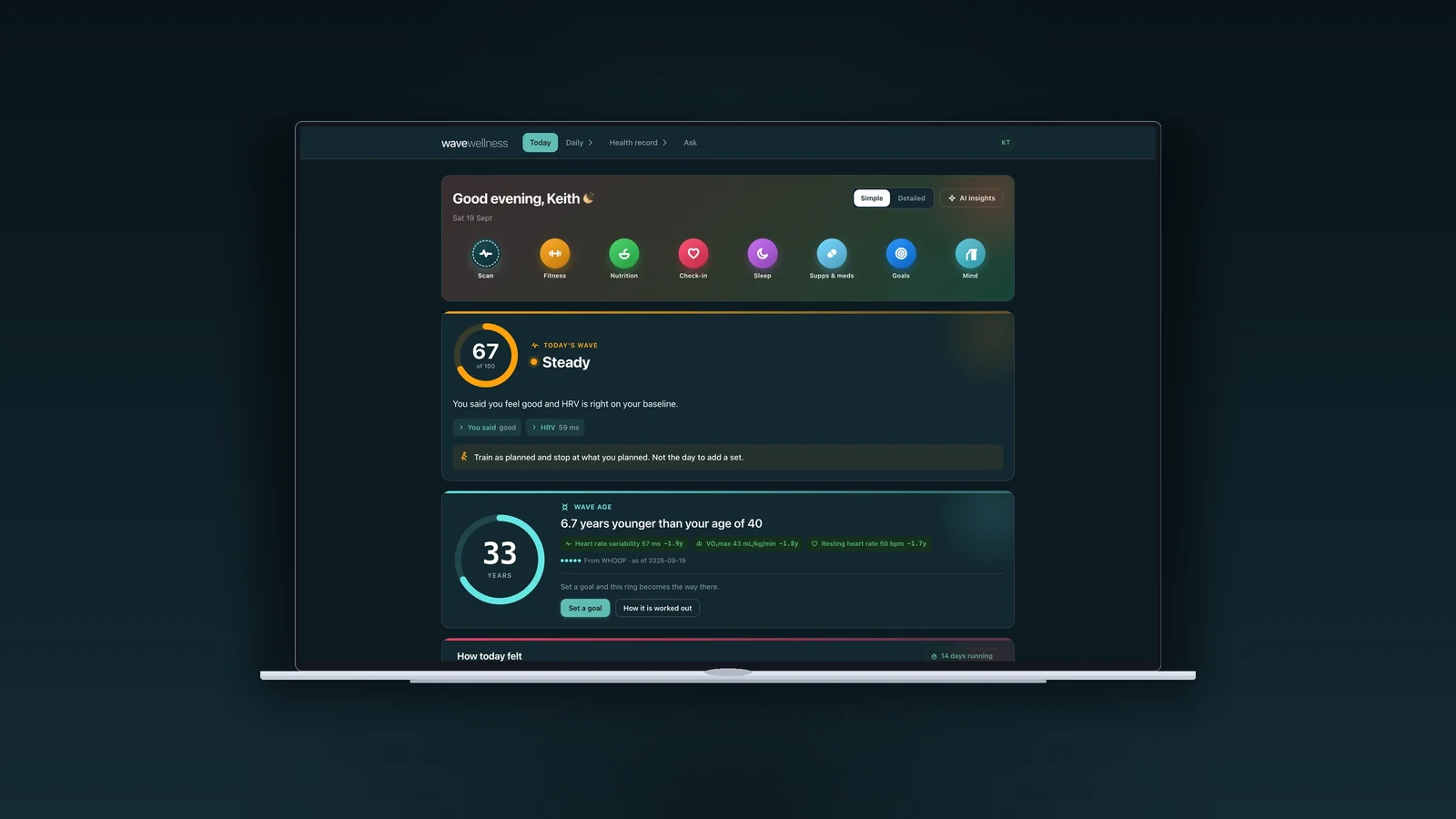
The launch is unusual in that it is not staged. The company's platform list has iPhone on iOS 18 or later, Apple Watch on watchOS 11 or later, Android 8 or later, any modern browser, macOS, iPad and the iPhone Duo, and says all of them arrive in October together. One account, one record, and the scan you took on the phone and the meal you logged in a browser are a single story rather than two. The web app in particular is the full record rather than a preview of it, which matters for anyone who would rather read a year of lab trends on something larger than a phone. Beta testing is running now, and the same waitlist form doubles as the application to join it.
Free, and the obvious question about that
Wave Wellness is free, with no subscription, no upgrade wall and no card to enter, and the company is explicit that this is not a beta price that changes after launch.
The obvious question about a free health app is what it costs you instead, and the answer the company publishes is worth reading closely. Its page for advertisers describes sponsorship on lifestyle surfaces only, meaning Today, nutrition, fitness and the face scan, and states that there is no placement available on results, trends, protocols, messages or the biological age. Creative is an uploaded image hosted by Wave and served from the app's own origin, and the page says the app carries no advertising identifier, no pixel and no third-party script, so nothing about a user leaves the app.
On data, the company's language is unusually absolute: never sold, never shared, never licensed and never disclosed to anyone, including advertisers, partners and device makers. The privacy page describes the app as built to HIPAA-aligned standards, with records encrypted in transit and at rest, stored in the United States on Cloudflare, and exportable in an open format or deletable in full at any time, with confirmation when it is done.
"We are not going to sell a subscription to somebody for the privilege of finding out whether they slept badly, and we are certainly not going to sell the answer to anyone else," the company said. "Wellness apps know an unusual amount about you. We built this one on the assumption that you should always be able to see all of it, take all of it and delete all of it, and that the day we make that hard is the day we have lost the plot."
Not a medical device, and the app says so
The disclaimer is not buried. Wave Wellness describes itself, on the site and inside the app, as a general wellness app rather than a medical device: it does not diagnose, treat, cure or prevent anything, none of it has been evaluated by the FDA, and every score, reading, age and insight is a wellness measurement derived from data you provided or connected. The trends screen carries a line reminding the reader that a value outside a range is a reason to talk to a doctor rather than a finding on its own, and that a value inside one does not rule anything out.
"The honest pitch is that you walk into your next appointment with a year of real data instead of a guess," the company said. "That is a better conversation with your doctor, not a replacement for one, and any company in this category telling you otherwise is selling you something."
Built on the Route 110 corridor
For a Long Island reader the geography is part of the story. Wave Wellness is designed, built and operated at 200 Broadhollow Road in Melville, and the company makes a point of it: the people who decide what the app says to you at seven in the morning work in Suffolk County, and a message sent through the contact form is read by one of them between nine and six, Monday to Friday. Wave Agency also keeps a working office in Boca Raton and is opening one in Miami, but the product team is here.
The agency has been running marketing and building software from Long Island since 2001, for national brands and for the publications it runs itself, and it has spent the last two years turning that work into products. Wave Wellness, which it built and is a partner in, is the first of them aimed directly at the public.
Next: the same platform, with a practice's name on it
The piece of this that is likely to matter most on Long Island is not the consumer app at all. There is a practice version that the company expects to ship by the end of 2026, and it is white label: a longevity, functional or concierge practice puts its own name, mark and colors on it, in the app and on every email it sends, so a patient never has to learn a vendor's brand to read their own results.
The argument is the same one the consumer app makes, aimed at a clinic instead of a person. A practice ends up with results in one portal, wearables in another, protocols written down in prose and the whole conversation in email, and the work of joining those together falls on whoever has the least time. The practice version puts labs, wearables, nutrition and protocols on one timeline, with the same rule that nothing reaches a chart until a human confirms it. A patient's question about a specific marker opens on the screen showing that marker, and the thread carries the result, its value and the day it was drawn at the top, so nobody has to ask which reading you mean and the answer is filed against it permanently. Before an appointment the record assembles itself into a pre-visit brief of confirmed results, protocols and what was asked since last time, and states plainly on its face that nothing in it has been interpreted.
Several pieces land with it that the consumer app does not have. The face scan runs in a plain browser, using the phone app's own signal chain ported across and held to the same tests, so a practice can take a reading in the waiting room or on a video call with nothing to install. Practices set their own optimal bands rather than inheriting a lab default, on the reasoning that a standard reference range is a not-sick range rather than a target. And an integration with a practice's existing chart system is specified endpoint by endpoint against a real vendor's published API, read-only on purpose because that vendor offers no sandbox and a write would hit live patient data on the first test.
The company is also careful about what it will not yet say. Its own page states that the practice version is not today a HIPAA-covered service and does not claim to be, that every read and write of health data goes through one guarded interface with an audit entry the application cannot skip, and that moving to HIPAA-eligible hosting under a business associate agreement is part of the practice release rather than a promise made after it. Until that is signed, the page says, the word compliant will not appear on it.
"Any vendor can print a compliance badge on a page. We would rather tell a practice exactly where we stand now and let them check it during their own diligence, because they are going to check anyway and the ones worth working with will respect the answer," the company said. "Doctors on Long Island are being sold longevity software constantly at the moment. Almost none of it has ever had a patient open it voluntarily. We built the patient side first, on purpose, and the practice version is that same record with your name on the door."
About Wave Wellness
Wave Wellness is a general wellness app that brings sleep, movement, nutrition, recovery and mood into one daily picture. It is built by Wave Agency. Patent pending. It reads the wearable somebody already owns through Apple Health and a direct WHOOP connection, takes a forty second reading from the phone's front camera, charts bloodwork from a photographed result sheet, and returns one score from 0 to 100 each morning with a plain sentence explaining why it moved. It also produces Wave Age, a biological age built on the published PhenoAge model with every year attributed to the signal that earned it. The app launches in October 2026 on iPhone, Apple Watch, iPad, Android and the web simultaneously, and beta testing is running now. It is free, with no subscription, no upgrade wall and no card. Wave Wellness is a wellness app and not a medical device; it does not diagnose, treat, cure or prevent any disease, and none of it has been evaluated by the FDA.
Wave Wellness
Web: wavewellness.app
Early access and beta: wavewellness.app
For practices: wavewellness.app/for-practices
Advertising: wavewellness.app/advertisers
Privacy policy: wavewellness.app/privacy
Contact: wavewellness.app/contact, where a person answers Monday to Friday, 9am to 6pm Eastern
Address: 200 Broadhollow Road, Suite 207, Melville, NY 11747
About Wave Agency
Wave Agency is a marketing, media and technology firm founded in 2001 and headquartered in Melville, New York, on the Route 110 corridor. It runs marketing for national brands, builds websites, native applications and the software underneath them, and publishes titles of its own. The agency writes and operates three platforms that its own properties and its clients run on: Wave Publisher, the publishing platform behind Long Island Wave and Creations Magazine; Wave Community, the membership platform the Melville Chamber of Commerce runs on; and Wave Workforce, the agentic platform the agency runs itself. It also built Wave Wellness and is a partner in it. It keeps a working office in Boca Raton and is opening a third in Miami.
Wave Agency
Web: waveagency.com
Headquarters: 200 Broadhollow Road, Suite 207, Melville, NY 11747, 631.517.0010
Florida: 433 Plaza Real, Suite 275, Boca Raton, FL 33432, 561.221.2144
Miami, Florida: opening soon
Hours: Monday to Friday, 9am to 6pm Eastern
Contact: waveagency.com/contact
Book a meeting: waveagency.com/book
Disclosure: Long Island Wave is published by Wave Agency, which built Wave Wellness and is a partner in it.
Loading comments…