
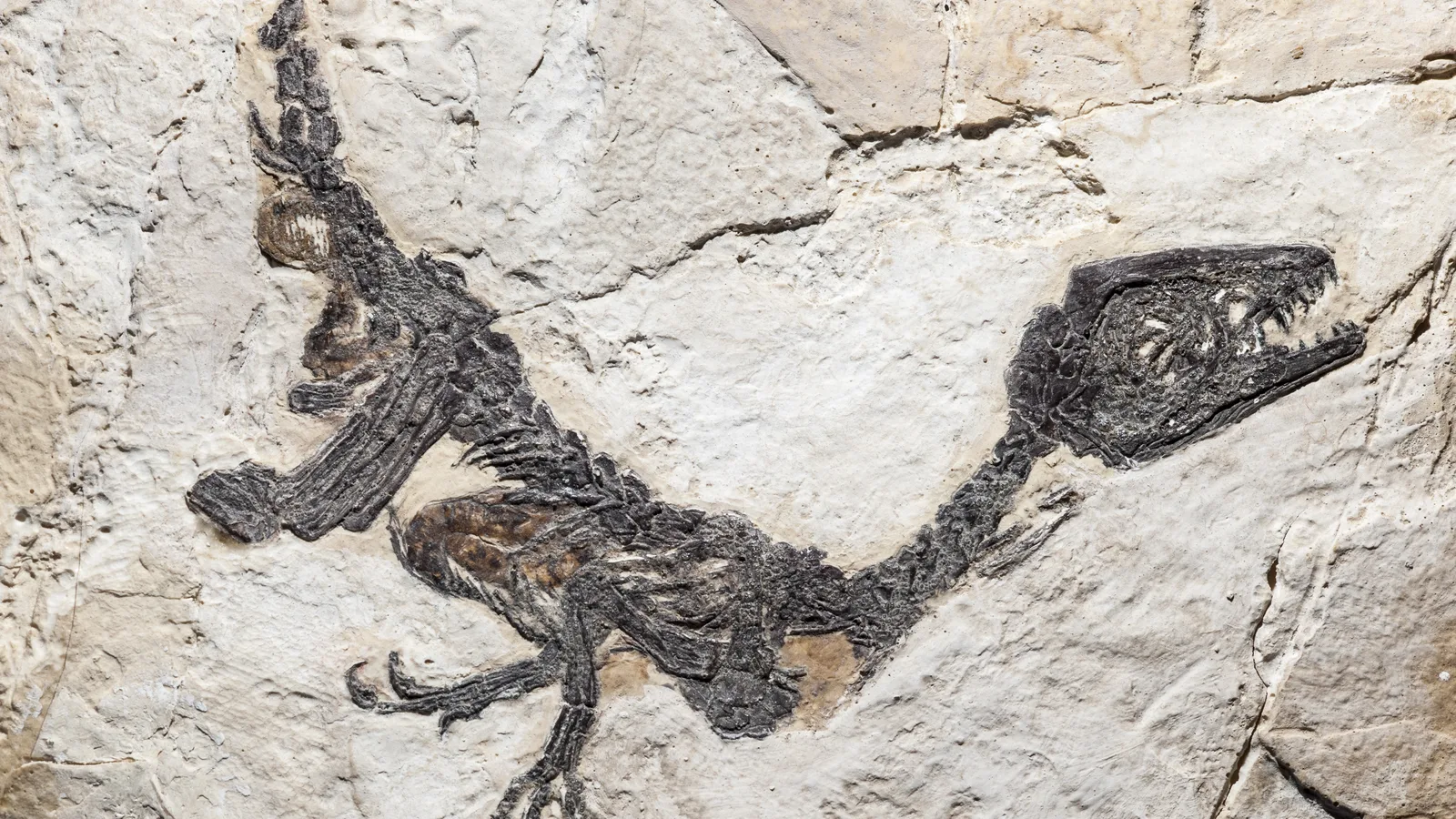
A paleontologist at Stony Brook University has led the team that named the first dinosaur known to have been built for eating fruit. The animal, a small, toothless, feathered dinosaur about the size of a turkey, has been given the scientific name Infernogallus jamesi. The first half of that name means hell chicken.
The discovery was published in the journal Nature Communications and announced by Stony Brook University on October 28. The work was led by Greg Funston, an assistant professor in the Department of Anatomical Sciences at Stony Brook's Renaissance School of Medicine, with colleagues from the Royal Ontario Museum in Toronto and the North Dakota Geological Survey.
Why it is called the hell chicken
The fossils come from the Hell Creek Formation, a band of rock that runs across Montana, North Dakota, South Dakota and Wyoming. It is the same ground that has produced Tyrannosaurus rex and Triceratops, and this dinosaur lived among them near the end of the Cretaceous period.
The find includes a nearly complete skull, still joined together as it was in life, and part of the skeleton. Those bones are now on display at the Royal Ontario Museum.
Infernogallus belongs to a group called caenagnathids, toothless and feathered relatives of the oviraptors that walked on two legs. According to the university, it weighed roughly 12 kilograms, or about 25 pounds, which makes it one of the smallest members of its group even as a full-grown adult. For more than a century, scientists had little idea what the skulls of these animals looked like.
How a dinosaur chewed fruit
The team used CT scans to rebuild the skull and study the bones that form the roof of the mouth. Those bones arch down into the mouth, which turned some of the jaw muscles so they ran front to back rather than up and down.
That arrangement would have let the beak slide back and forth as it closed, closer to the way a person chews than to the straight up-and-down bite of T. rex. Muscles set this way are uncommon in the animal kingdom. Among living animals they show up in mammals that chew their food, including humans, and in birds that specialize in fruit, such as the vulturine parrot.
From that match, the researchers concluded the skull was built to mash soft food in the mouth, specifically stone fruits, stripping the flesh away from the seed in the middle.
A plant eater from a meat-eating family
Infernogallus and its relatives evolved from the meat-eating branch of the dinosaur family tree. During the Cretaceous, flowering plants took over from cone-bearing plants as the main vegetation on land, and the fossil record from that time includes fossilized fruit.
Paleontologists had struggled to tie dinosaur diversity to the rise of flowering plants. The team's analysis found that caenagnathids developed their specialized chewing as fruits grew larger and more common, and the authors say that raises the possibility that dinosaurs helped spread the seeds of early flowering plants, a job birds, reptiles and small mammals do today.
Complete remains of small dinosaurs like this one are rare in the fossil record, according to the Royal Ontario Museum's chief curator of natural history, David Evans, who is the senior author of the paper. Thomas Dudgeon, a postdoctoral fellow at the museum, is a co-author.
A dinosaur lab in Stony Brook
Funston teaches anatomy at the Renaissance School of Medicine, the medical school on the Stony Brook University campus, and is the corresponding author of the paper. Stony Brook's anatomical sciences department has a long record in paleontology research, and this paper adds a new species to it.
Readers who want the full science can read the open paper in Nature Communications, and Stony Brook University has posted the announcement, with an illustration of the hell chicken eating fruit while a T. rex watches from behind, on its news site.
Loading comments…