



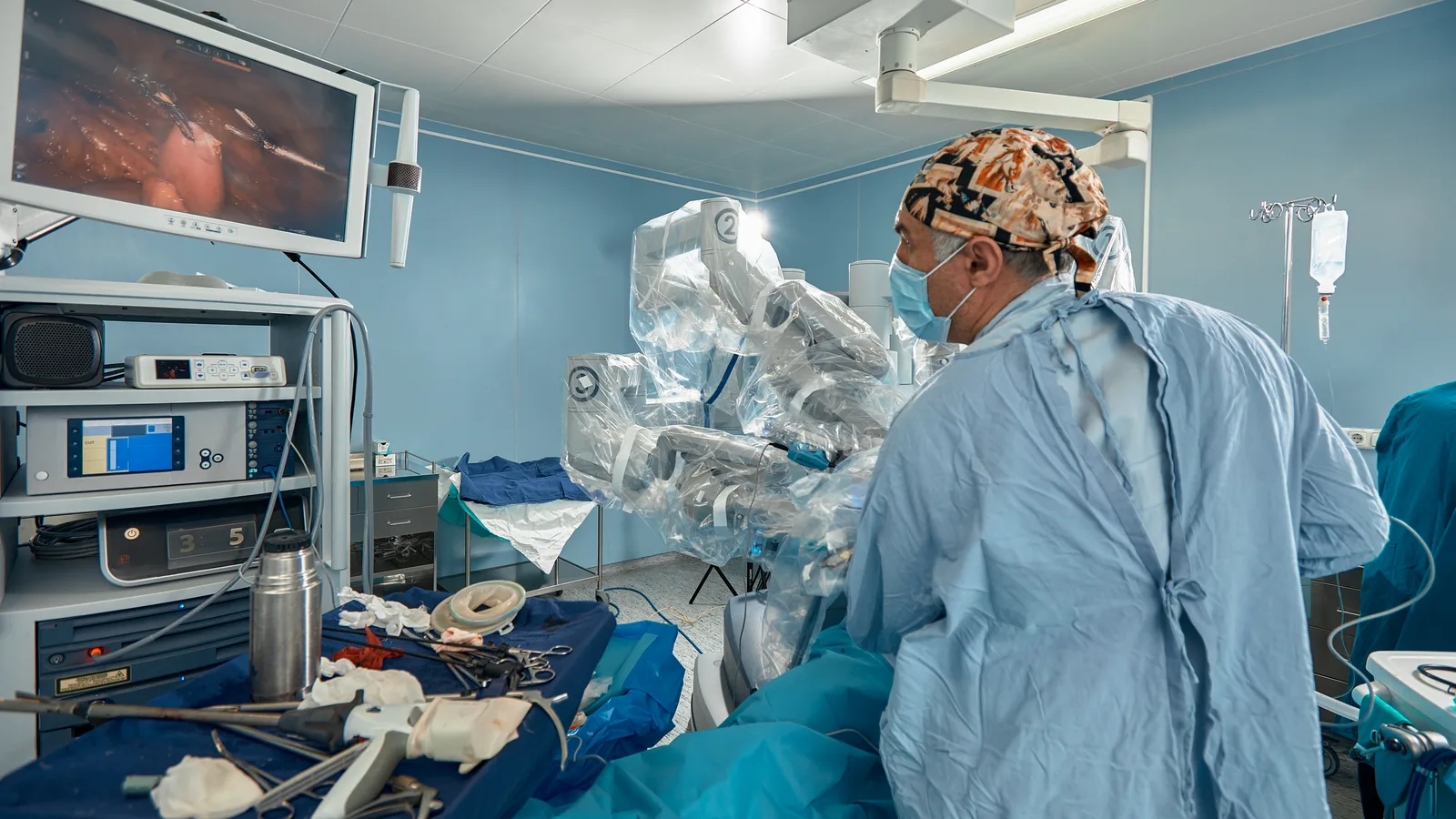
Robots built and studied at Stony Brook University are the subject of a partner feature in the journal Nature, published this month. The piece follows the university's healthcare robotics work into three places: the operating room at Stony Brook University Hospital, a test home on the university's research campus, and the design of a prosthetic leg that can read the ground ahead of it.
Stony Brook announced the feature on November 5. For readers in Suffolk, the most immediate part of it is the first one, because it describes how a large share of complex surgery at the hospital on Nicolls Road is already done.
A surgeon at a console
Georgios Georgakis, MD, is an associate professor of surgery at Stony Brook's Renaissance School of Medicine, where his specialty is surgical oncology and cancer research. In 2017 he helped perform Stony Brook University Hospital's first fully robotic Whipple procedure, a pancreatic operation that sits among the most demanding in abdominal surgery.
Today, according to the feature, about 80 percent of his operations are robotically assisted. He works from a console a few feet away from the patient, and the system scales his hand movements down to instruments only a few millimeters across. Georgakis describes the change as surgery becoming more computerized, with a machine now sitting between the surgeon and the patient. Surgeons have to relearn how they approach an operation, he says, even though the movement that reaches the patient ends up the same.
The Nature piece uses Stony Brook's surgical program as its example of how the role of the surgeon is changing as more of the work passes through a computer.
A robot arm that caregivers teach
The second section of the feature moves to Stony Brook's Center of Excellence in Wireless and Information Technology, known as CEWIT, on the university's research and development campus. There, the Home of the Future Lab is set up as a realistic home, built to test technology meant to help older adults keep living independently.
One of the projects in that lab is the Caregiving Robot Assistant, or CART, developed by I.V. Ramakrishnan, a professor of computer science at Stony Brook. CART is a mobile robotic arm designed for people living with amyotrophic lateral sclerosis, or ALS, a disease that steadily takes away mobility. People with ALS can need help with dozens of small tasks a day, from scratching an itch to clearing saliva that could cause choking, and much of that work falls on family members.
CART is meant to take part of that load. A family caregiver teaches the arm a task by physically guiding it through the motion, such as fetching a glass of water, and the robot learns to repeat it. Because each person's needs are different, the system is built to be trained by the people who know the patient best rather than programmed in advance.
A leg that reads the ground
The third part of the feature concerns a smart prosthetic leg. Most prosthetic legs in use today are passive, which means the person wearing one has to supply the force that moves it. A leg that can anticipate the terrain could share some of that effort, but only if it correctly reads what is underfoot: a curb, a slope, a step, a patch of grass. People make those judgments almost without thinking.
Zhaozheng Yin, an associate professor of computer science and biomedical informatics at Stony Brook, worked with the engineers building the leg on its sensing. His position, as the feature describes it, is that a prosthetic cannot behave more like a human limb until it can perceive its surroundings the way a person does.
Why it matters on Long Island
All three projects come out of one university in Stony Brook. The robotic surgery is part of routine care at Stony Brook University Hospital now, while the caregiving arm and the prosthetic leg are still research projects. The feature does not give a date for either to reach patients.
How to read the feature
The Nature partner feature is posted online, and Stony Brook's own summary of it is posted on the university's news site. Patients interested in robotic surgery at Stony Brook University Hospital can ask their physician for a referral to the hospital's surgical services,.
Loading comments…