
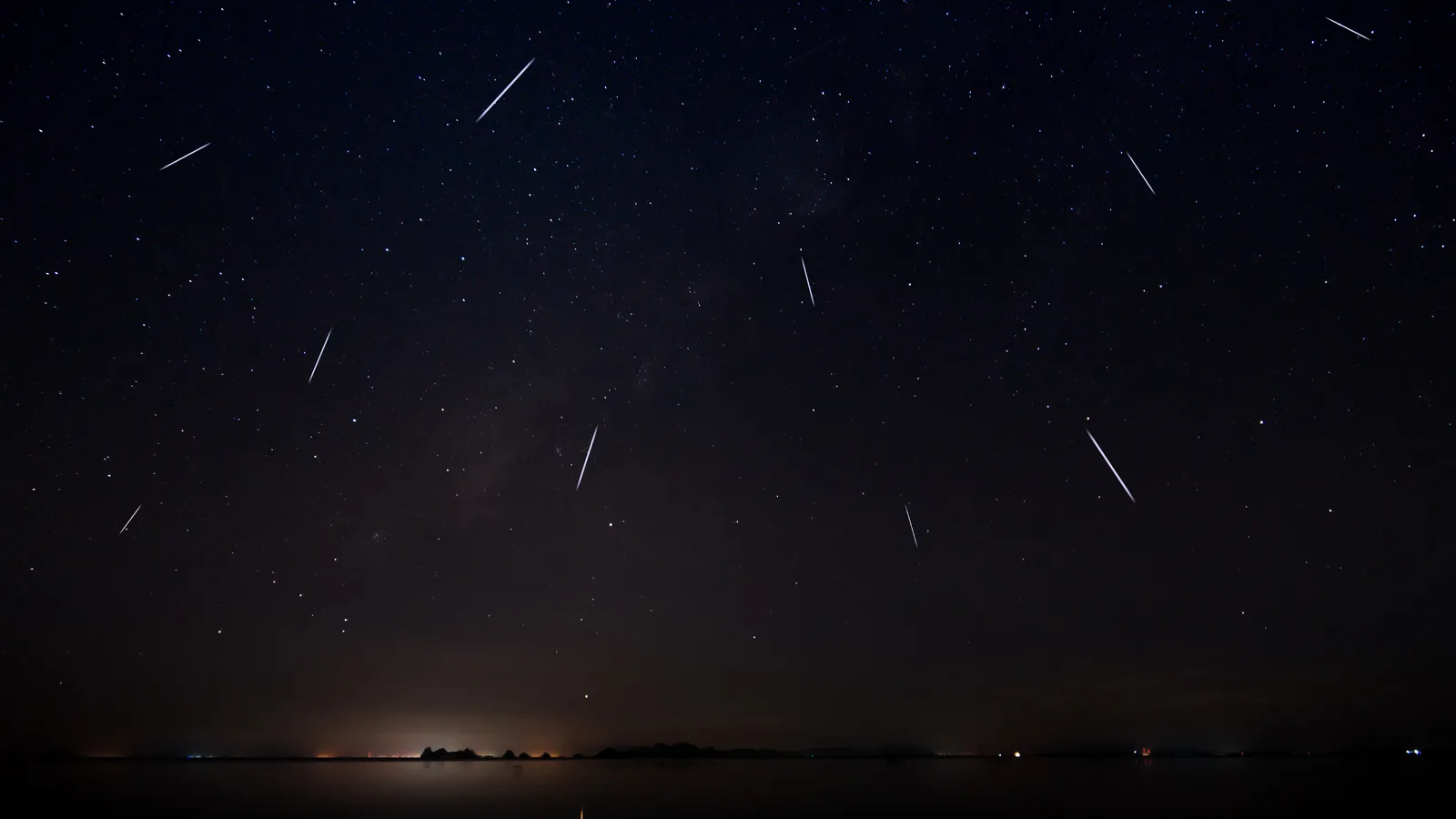
The Perseid meteor shower reaches its peak overnight Wednesday into Thursday, August 12 into 13, and this year the sky is doing Long Island a favor it rarely does. The moon is new on August 12. That means zero moonlight, all night, on the one night of the year when the sky throws its most reliable show.
Most Augusts, that is the detail that quietly wrecks the Perseids. The shower itself barely varies from year to year, but a bright moon washes the faint meteors out of the sky, and the faint ones are most of them. The American Meteor Society, which publishes the standard calendar for these events, lists the 2026 Perseids as active from July 17 through August 24, peaking on the night of August 12 into 13, with viewing conditions this year rated optimum precisely because the moon is dark.
What you can actually expect to see
Under a genuinely dark rural sky, the Perseids produce roughly 30 to 50 meteors an hour at maximum. That is the honest number, not the inflated one that circulates every August. It works out to a meteor every minute or two, some of them faint scratches, a few of them bright enough to leave a glowing trail that hangs in the sky for a second after the meteor is gone.
In a suburban backyard in Nassau or western Suffolk, the count will be lower, because street lights and porch lights do to faint meteors what the moon usually does. But the brightest Perseids, the fireballs, punch through suburban skyglow without any trouble. With the moon out of the picture, even a lawn chair in Levittown gets you something this year, provided you kill the lights you control and give your eyes twenty to thirty minutes to adapt.
The meteors are debris from comet Swift-Tuttle, sand-grain and pea-sized particles the Earth plows through every August, burning up around 60 miles overhead. They appear to stream out of the constellation Perseus, which climbs the northeastern sky late in the evening. That geometry is why the hours after midnight are better: the radiant rises higher, and your side of the planet turns to face the oncoming debris head on.
How to watch it properly
No telescope, no binoculars. Meteors cross too much sky too fast for either. The whole technique is a reclining chair or a blanket, a view of as much open sky as you can manage, and patience measured in half hours rather than minutes.
Aim your gaze high and generally away from the northeast rather than directly at Perseus. Meteors near the radiant look short and stubby; the long dramatic streaks show up 45 degrees and more away from it. Overhead is never wrong.
The window that matters runs from roughly midnight until the first hint of dawn on Thursday morning. If you can only spare one stretch, make it the two hours before morning twilight, which is when the rates run highest.
Where Long Island is dark enough to matter
The Island has a simple light-pollution gradient: it gets darker as you go east and as you get away from the developed spine. The darkest accessible skies are on the two forks and along the barrier beaches, where the Atlantic or the bays swallow half the horizon and there is nothing south of you but ocean until the Bahamas.
For company and telescopes, there is the Custer Institute and Observatory on Main Bayview Road in Southold, which opens to the public every Saturday evening. Doors open at 8 p.m. and observing runs from dark until midnight if the sky cooperates. The peak falls on a Wednesday this year, but the shower does not switch off after its peak night, and a Saturday evening on the North Fork with volunteers and telescopes is a fine consolation if the middle of the week is impossible.
Wherever you go, the practical constraints are the boring ones: many parks and beaches formally close at dusk, parking rules on the East End are enforced with enthusiasm, and the difference between a good spot and a great one is mostly whether a parking lot light is shining in your face. A dark backyard beats a bright beach.
If Wednesday is cloudy
An August forecast on Long Island is a coin flip, so it helps that the Perseids are not a one-night event. Activity stays respectable for several nights on either side of the peak and the shower runs through August 24, though rates fall off faster after the peak than before it. Thursday night into Friday morning is the best backup. The moon stays close enough to new through the week that it will not spoil anything.
What makes this year worth the lost sleep is the arithmetic of the calendar. The Perseids come every August, but a peak night with no moon at all is the exception, and the next ones are years out. A shower that reliable meeting a sky that dark is the kind of coincidence you take when it is offered, especially when all it costs is a lawn chair and a Thursday morning coffee.
Loading comments…