
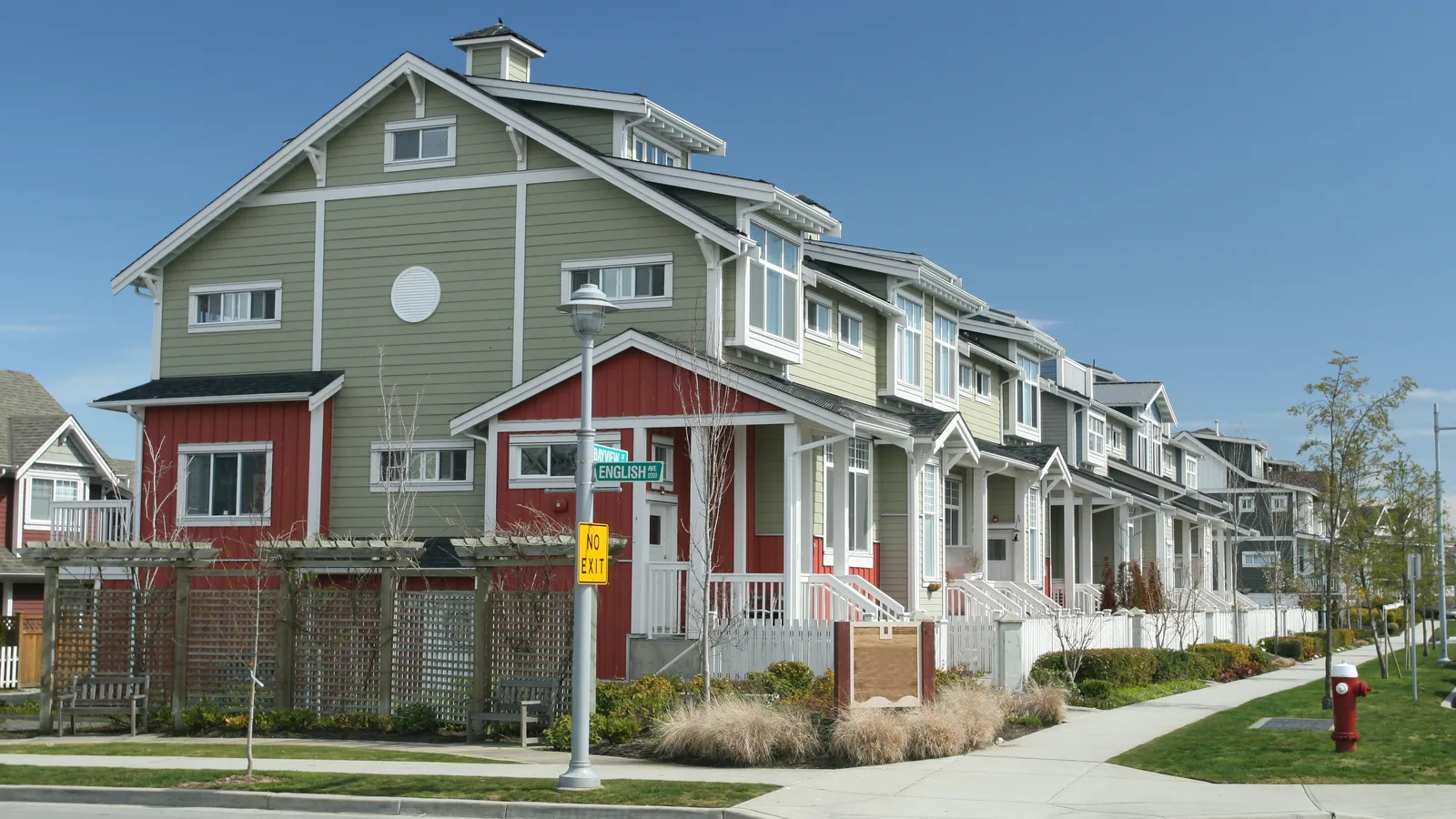
The corner of Elwood Road and Pulaski Road has been a name in Huntington politics for so long that people who fought over it as young parents have grandchildren now. Matinecock Court was first proposed in 1978. On Tuesday the state announced it is finished: 145 affordable co-op homes across 17 two-story buildings, built on 14.8 acres that sat argued-over and empty for close to half a century.
What actually got built
The $98 million development is a limited-equity cooperative, which is the part worth slowing down for, because it is rare on Long Island. Residents do not rent. They buy shares in the co-op at a price kept deliberately low, own their homes, and agree that when they sell, the resale price stays capped so the next family gets the same deal. It is ownership designed to stay affordable permanently, rather than affordable once and market-rate the moment the first owner cashes out.
The homes come in one-, two- and three-bedroom layouts and are open to households earning up to 80 percent of the area median income. Within the 145 are eight supportive apartments for people with developmental disabilities, with services run by AIM Services Inc., plus four homes set aside for veterans, 15 built for residents with mobility disabilities and six adapted for people with sensory disabilities. There is a clubhouse, on-site parking and individual patios, and the Northport train station and county bus lines are close by.
The longest housing fight on Long Island
What makes this a story is not the ribbon. It is the calendar. Housing Help Inc., the Greenlawn nonprofit that spent decades pushing the project, proposed affordable housing on this site when Jimmy Carter was president. The plan ran into years of resistance over zoning in the Town of Huntington, and the dispute became one of the defining fair housing cases in the country. The NAACP took up the fight, and in 1988 the litigation reached the United States Supreme Court, which let stand a ruling that Huntington's zoning practices had violated the federal Fair Housing Act. Law students still read that case. The settlements that followed are what eventually made the project possible.
Even then, eventually meant decades more of financing rounds, redesigns and approvals. The development that opened this week was built by D&F Development Group of Levittown in partnership with Housing Help, with a funding stack that tells its own story about how hard affordable ownership is to build here: roughly $36 million in expected equity from federal and state low-income housing tax credits, $28 million in state subsidy, $4.2 million from Suffolk County housing programs, $1.7 million from the state Office for People With Developmental Disabilities and a $1 million state economic development grant.
Why it matters beyond one corner
Long Island's housing math is familiar to anyone who has tried to stay here: young families priced out, older residents with nowhere smaller to move, workers commuting in from two counties away. What almost never gets built is a path to owning something. Rental complexes with an affordable set-aside have gone up across both counties. A co-op where a household earning a working salary can buy in, build stability and pass the opportunity along is a different animal, and 145 of them landing at once makes Matinecock Court one of the largest affordable ownership projects Long Island has seen in a generation.
It also closes a civic wound. The fight over this parcel was never really about one field in East Northport. It was about whether the town would make room, and the answer, delivered 48 years late, is a built thing with driveways and patios rather than a court filing. The families moving in will mostly know the history secondhand. That is what winning a fight like this looks like: eventually, ordinary life on the lot everyone spent decades arguing about.
What happens next
The development is complete and residents are moving in through the affordable housing process run by the developers and the state. For everyone else, the change is simpler. A corner that has been a symbol since 1978 is now just a neighborhood, with lights on in the windows at Elwood and Pulaski. Few places on Long Island have waited longer for something this ordinary.
Loading comments…