

Man Cave Health is an Oyster Bay nonprofit with a straightforward goal: help men catch prostate cancer early, and make sure no man goes through it alone. It brings free PSA blood tests to the places men already gather, from game days and car shows to job sites and community events, and it now has a mobile screening van on Long Island run with Northwell Health.
One man's diagnosis
Man Cave Health began with its founder's own test result. In November 2015, a routine blood test gave Thomas Milana Jr. an alarming PSA result. He was diagnosed with prostate cancer, underwent successful robotic surgery in April 2016, and remains cancer-free today. The experience showed him how little existed to help men navigate a diagnosis, and how few places made men comfortable enough to show up for a screening at all.
His family had already established the Milana Family Foundation. In 2018 they shifted the Foundation's mission toward giving men a comfortable place for prostate cancer education and testing, and Man Cave Health was born. Its stated mission is "to empower men to make proactive healthcare decisions that protect their lives and strengthen their families."
Why early detection matters
Prostate cancer is the most common cancer in American men. Citing the American Cancer Society, Man Cave Health notes that one in eight men in the United States will be diagnosed with it in his lifetime, and that when it is caught early, the five-year survival rate is over 99 percent. More than 300,000 new cases are diagnosed in the country every year. As the organization puts it, "The problem isn't the disease. It's that men don't get tested."
The test itself is simple. PSA stands for prostate-specific antigen, a protein made by the prostate, and a PSA test measures its level from a small blood sample. There is no fasting and no special preparation, and the draw takes about five minutes. Early-stage prostate cancer typically has no symptoms, which is exactly why a blood test matters.
The Van Cave arrives on Long Island
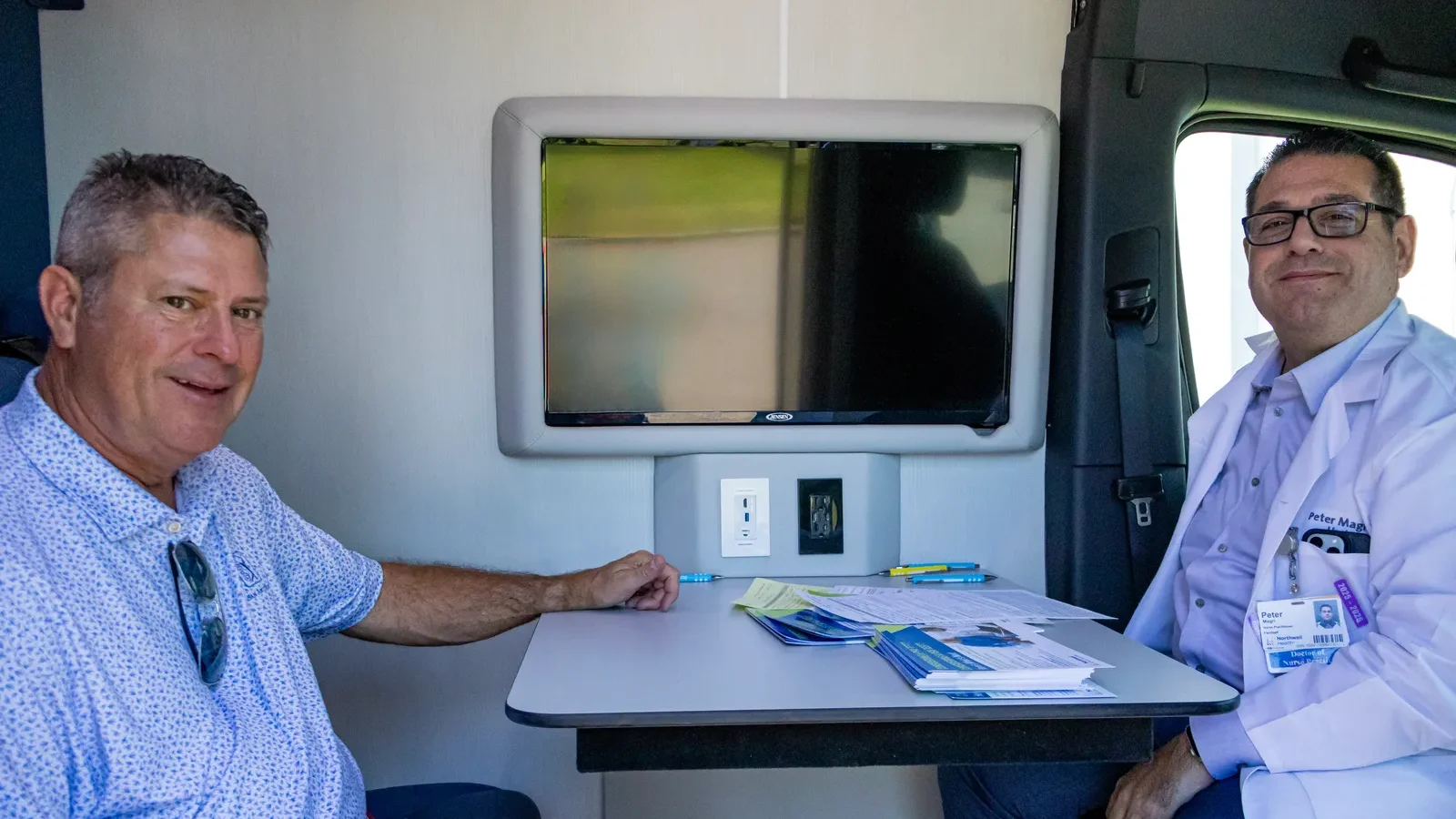
This fall, Man Cave Health joined Northwell Health and executives from M&T Bank and Wilmington Trust for a ribbon cutting celebrating the donation of a new Van Cave to Northwell Health. Man Cave Health and its financial partners shared the cost of the mobile screening unit, with M&T Bank and Wilmington Trust making a matching investment, and Northwell Health leads its clinical operations and ongoing community screening programs across Long Island and surrounding communities.
A Van Cave is a private, comfortable space built for men, with no waiting room and no pressure. The idea behind it is summed up in a line Man Cave Health uses often: "We don't ask men to come to healthcare. We bring healthcare to men."

Each Van Cave is run with a leading health system in its region: Northwell Health in New York, Boston Medical Center in Massachusetts, the Michigan Men's Health Foundation, and UCI Health in Southern California, with a Mount Sinai Van Cave for New York City listed as coming soon. Man Cave Health reports more than 4,200 men screened to date.
How a screening works
At a Man Cave Health screening there is no appointment and no cost. A man walks up, has a quick blood draw, and Man Cave Health's medical partner shares the PSA result with him. If the result is elevated, a healthcare professional from that partner reaches out and connects him with a urologist. An elevated PSA does not always mean cancer, and the organization encourages every man to talk with his own doctor about how often to screen.
Close to home
Much of Man Cave Health's work happens where Long Islanders already spend their time. At a lacrosse rivalry game between Hofstra and Stony Brook, organized with Women and Men Against Prostate Cancer, players wore custom prostate cancer awareness socks through a double-overtime contest, fans took part in a pregame shootout, Lacrosse Unlimited donated custom-dyed sticks for a raffle, and former Hofstra standout Connor Hagans made an appearance. "This event proves that sports have the power to change the conversation," said Tom Milana, Chairman of Man Cave Health.
This year's local calendar included screenings at Oyster Bay Cruise Nights and the Empire State Ride Long Island in June, alongside the Milana Family Foundation's annual golf outing. In October, Man Cave Health hosted its First Annual Legacy Cocktail at Durvo in Roslyn, honoring the Milana family for the support that has helped advance the mission.
Support after the test
Man Cave Health also runs free virtual support groups on Zoom for men who have been diagnosed, are in treatment or recovery, are waiting on further testing after an elevated PSA, or simply want to talk openly about their health. Family members supporting a man through a diagnosis are welcome too. The East Coast group meets on the first and third Wednesday of each month at 6 PM Eastern, and the West Coast group on the second Wednesday at 6 PM Pacific. As Man Cave Health tells men thinking about joining: "It costs nothing to join. You don't have to share anything. You just have to show up."
Who should get tested
Based on American Cancer Society recommendations, Man Cave Health's screening guide suggests:
- At 50: men at average risk should talk with a doctor about PSA screening.
- At 45: African American men, and men whose father or brother was diagnosed before 65, should start that conversation.
- At 40: men with more than one close relative diagnosed at a young age should begin.
How to get involved
Man Cave Health's partners include Northwell Health and Catholic Health. Men can find an upcoming free screening on Man Cave Health's events calendar or read the screening guide. Employers, event organizers and health systems can host a Van Cave screening, and supporters can donate to fund free PSA tests, outreach and patient follow-up. Man Cave Health is a 501(c)(3) nonprofit at 34 Audrey Avenue in Oyster Bay, New York. Reach the helpdesk at (631) 393-5710 or [email protected], visit mancavehealth.org, and follow along on Instagram and Facebook.
Loading comments…