
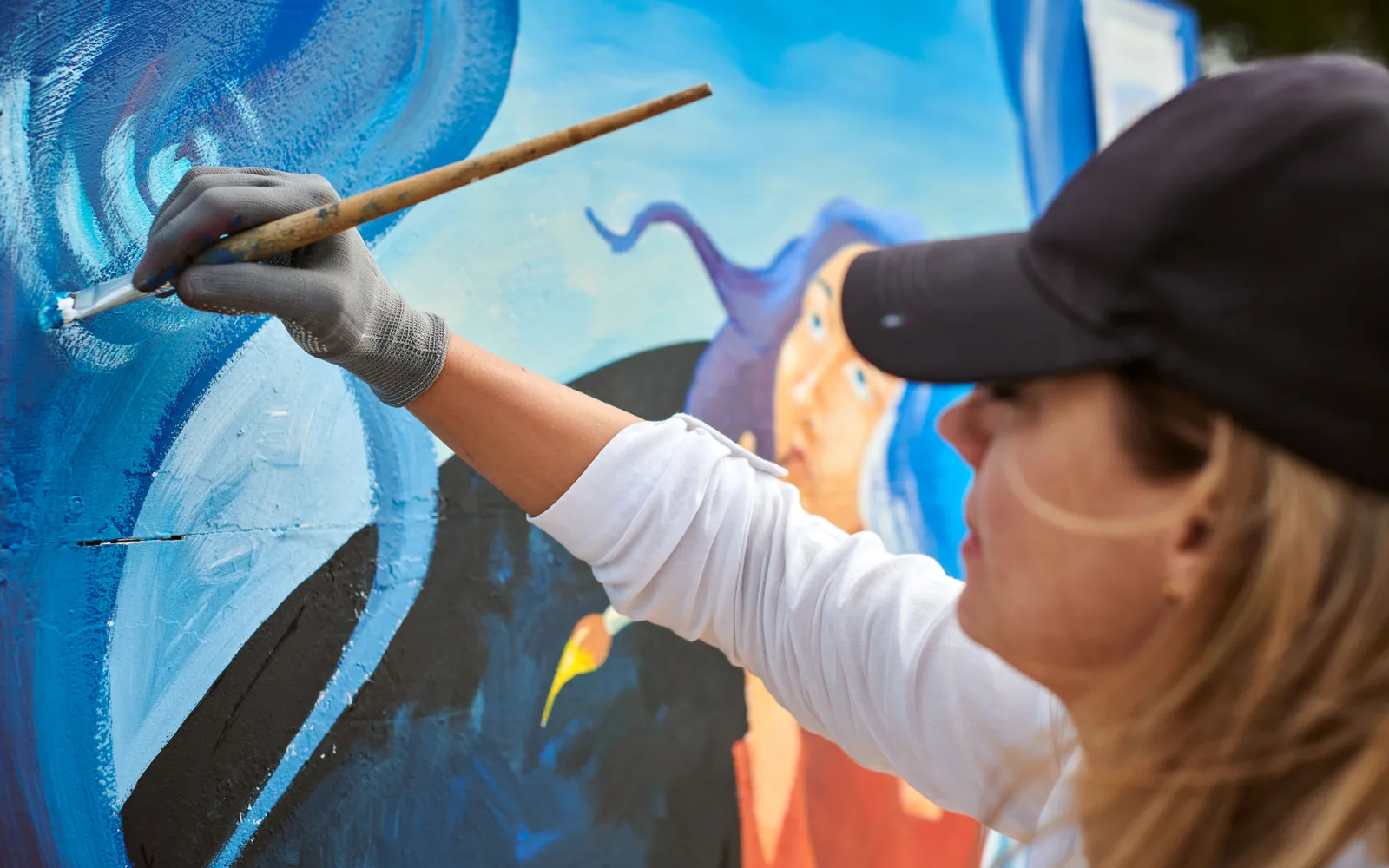
The ticket booths on the Long Beach boardwalk are the least loved pieces of architecture in the city. They are small, boxy, and their entire job is to stand between you and the ocean until you have paid.
Sixteen of them are now murals.
The project is called Tickets to Paradise, and it has spread this summer to every beach entrance along the 2.5-mile boardwalk. Each booth has its own theme. The artists are local, they volunteered their time, and the whole thing was paid for by sponsoring businesses and organizations rather than by the city.
How it started
It began in May with a single day of painting and six booths, run as a community event. The response was strong enough that the effort kept going rather than stopping at six, and it has since worked its way down the length of the boardwalk.
Local artist Michele Dodd, whose work inspired the project, painted three of the murals herself. One of hers marks the country's 250th anniversary. "The America 250 one is definitely very personal to me," she said. "I love my country."
Robert Rothman, another of the participating artists, put the point of the whole exercise more simply. "It's about bringing smiles to people's faces, bringing enthusiasm to a community."
City Council President Brendan Finn's assessment was similarly direct: "They're all beautiful and vibrant and I think just makes you happy."
What is on them
The themes range wider than you would expect from a beach mural project, and a few of them are not decorative at all.
There is marine life, and there is surfing, which are the two you would guess. There is the patriotic booth marking America's 250th. There are tributes to Waterfront Warriors, the organization that brings wounded veterans and their families to Long Beach each summer, and to veterans more broadly.
And there is a memorial to Austin Gibbons, a Long Beach lifeguard. That one is why the project reads as something other than a beautification exercise. A boardwalk that carries a community's memorials is doing more work than a boardwalk that carries advertising.
Why this is a bigger deal in Long Beach than it would be elsewhere
The Long Beach boardwalk is not just a nice walk. It was destroyed by Hurricane Sandy in October 2012, torn apart along nearly its entire length, and the city rebuilt it from the pilings up over the following two years at a cost of more than $40 million. The version people walk today is barely a decade old.
A city that had to rebuild its boardwalk once tends to be particular about what goes on it. Painting the ticket booths is a low-stakes, reversible, entirely local way of making the structure feel like it belongs to the people using it rather than to a public works department.
It also costs nothing publicly, which matters in a city that has spent the last decade carefully rebuilding its finances alongside its infrastructure. Long Beach recently approved a separate $601,000 package for crosswalks, sidewalks and other pedestrian improvements, and was awarded $1.45 million in state money toward boardwalk work that could include new concession buildings, three boardwalk extensions, shaded seating, restrooms, and space for local artists and artisans to sell their work.
That last item is worth noting. The state money contemplates giving local artists a permanent commercial spot on the boardwalk. The mural project got them there first, for free, on their own initiative.
Going to see them
The booths sit at the beach entrances, so the murals are effectively a self-guided walk down the boardwalk. Doing the full 2.5 miles from the East End to the West End covers all sixteen, which is a flat, easy hour on foot and considerably less on a bike.
Long Beach is one of the few Long Island beaches you can reach without a car. The LIRR's Long Beach Branch drops you a few blocks from the sand, and beach passes are sold at the entrances, which is what the booths are for in the first place.
Organizers say they expect to paint additional booths in the West End next year. Sixteen was not the target. It was just where this summer ended.
Loading comments…