
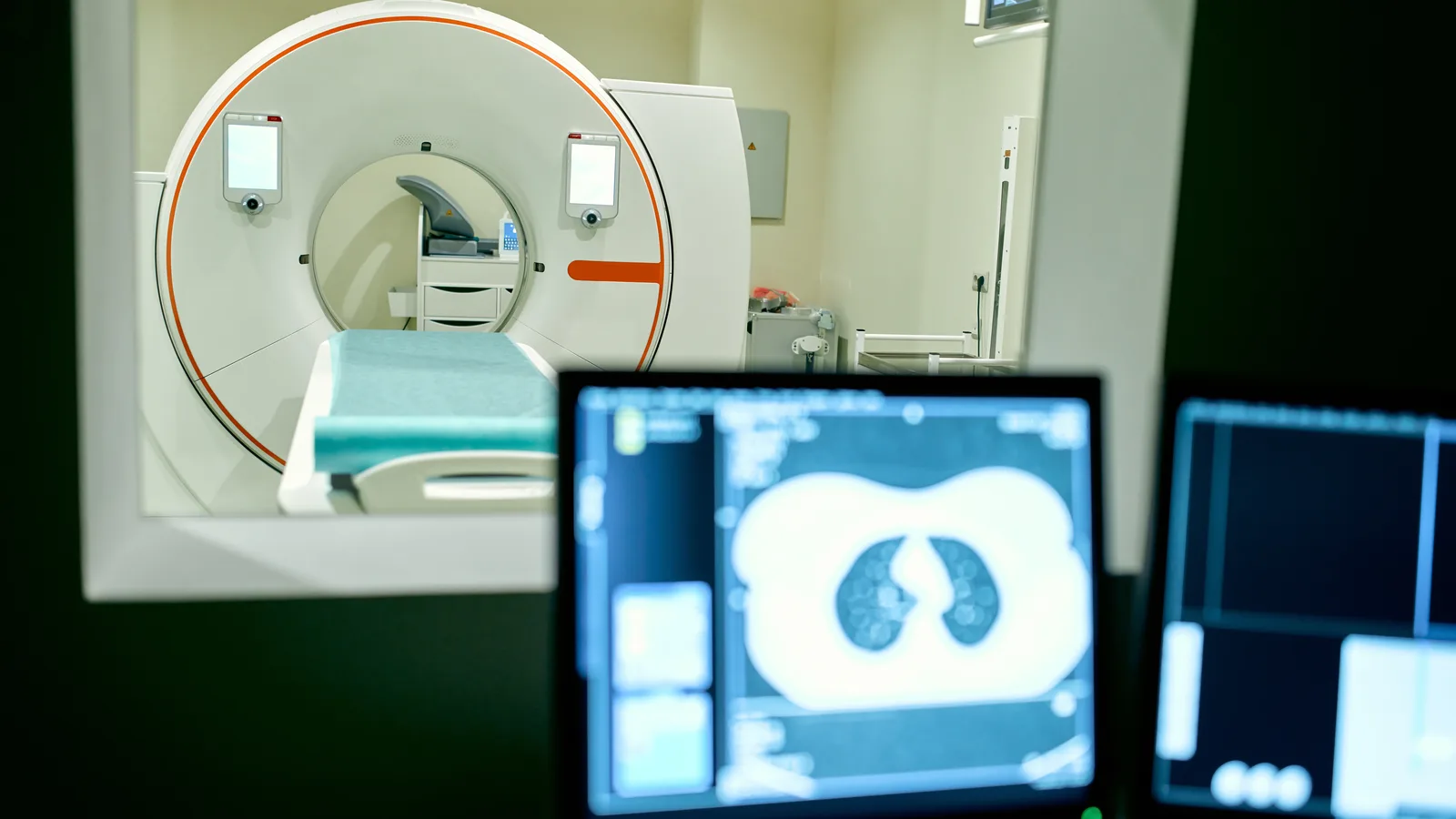
Long Island Jewish Valley Stream has installed a CT scanner that no other hospital in the Northwell Health system has, and starting in October it will use the machine for something the hospital has never offered before: advanced imaging of the heart, performed in Valley Stream instead of somewhere a referral sends you.
The hospital cut the ribbon on the scanner, a Siemens SOMATOM Pro.Pulse, at a ceremony on Friday, August 21. The investment came to roughly $1 million, and hospital leadership framed it as a direct answer to what the hospital sees in its own community: South Shore Nassau and southeast Queens carry a disproportionate burden of heart disease, and the equipment to look closely at a heart has mostly lived elsewhere.
What a dual source scanner actually does
The Pro.Pulse is a dual source CT, which means it carries two X-ray tubes and two detectors instead of one of each. The practical effect is speed. A heart never stops moving, and a conventional scanner has to work around that; a dual source machine captures images fast enough to freeze cardiac motion, which is what makes detailed pictures of coronary arteries possible without threading a catheter into anybody.
Siemens introduced the model recently and priced it near what hospitals pay for ordinary single source systems, a decision aimed squarely at the growing demand for cardiac CT. That is part of why a community hospital could bring one in: this class of imaging used to be a flagship purchase for a flagship campus, and it is becoming standard equipment.
The exams themselves produce three dimensional views that can show blockages in the coronary arteries, calcium deposits, and problems in the chambers, valves and aorta. The hospital expects to use the scanner for patients who meet the criteria for cardiac CT, including people with chest pain, shortness of breath or test results that did not settle the question, along with patients whose irregular or fast heart rates make them difficult to image on conventional equipment.
A year of planning for a village hospital
Hospital officials said at the ceremony that the project took about a year of planning before roughly six months of construction. The team researched vendors, weighed which technology its clinicians would actually be comfortable using, and traveled to Fort Myers, Florida to evaluate the machine in person before committing. The scanner is an addition, not a replacement; the hospital has been steadily replacing its imaging equipment in recent years, including the new CT scanner and X-ray suites that came with the emergency department rebuild.
Cardiac CT patients will be handled by a dedicated team that includes a CT specialized radiologic technologist, a registered nurse and a physician assistant, and the hospital says it is designing the experience to be simple from scheduling through the scan itself. Depending on what an exam shows, a patient might need nothing further, might need more testing, or might be sent on for a procedure elsewhere in the health system, but the sorting question, whether this heart needs intervention, gets answered locally.
Assemblywoman Michaelle Solages, who represents the area, supported bringing the technology to the hospital and pointed to early detection as the reason it matters: heart disease found early is a very different disease from heart disease found late.
What changes in October
The machine is installed and the ribbon is cut, but the cardiac exams begin in October, when the program formally opens. For a Valley Stream resident, the practical change is a short one to describe. A cardiologist who wants a detailed, noninvasive look at your coronary arteries will be able to order it at the hospital in the village, on a machine that, for now, nobody else in the largest health system in New York State can match.
Community hospitals have spent two decades watching advanced services consolidate at big regional campuses, and Valley Stream residents have done their share of driving to appointments accordingly. A million dollar scanner does not reverse that current by itself. But this is what the reversal looks like when it happens: quietly, one machine at a time, with the fancy equipment finally moving toward the patients instead of the other way around.
Loading comments…