
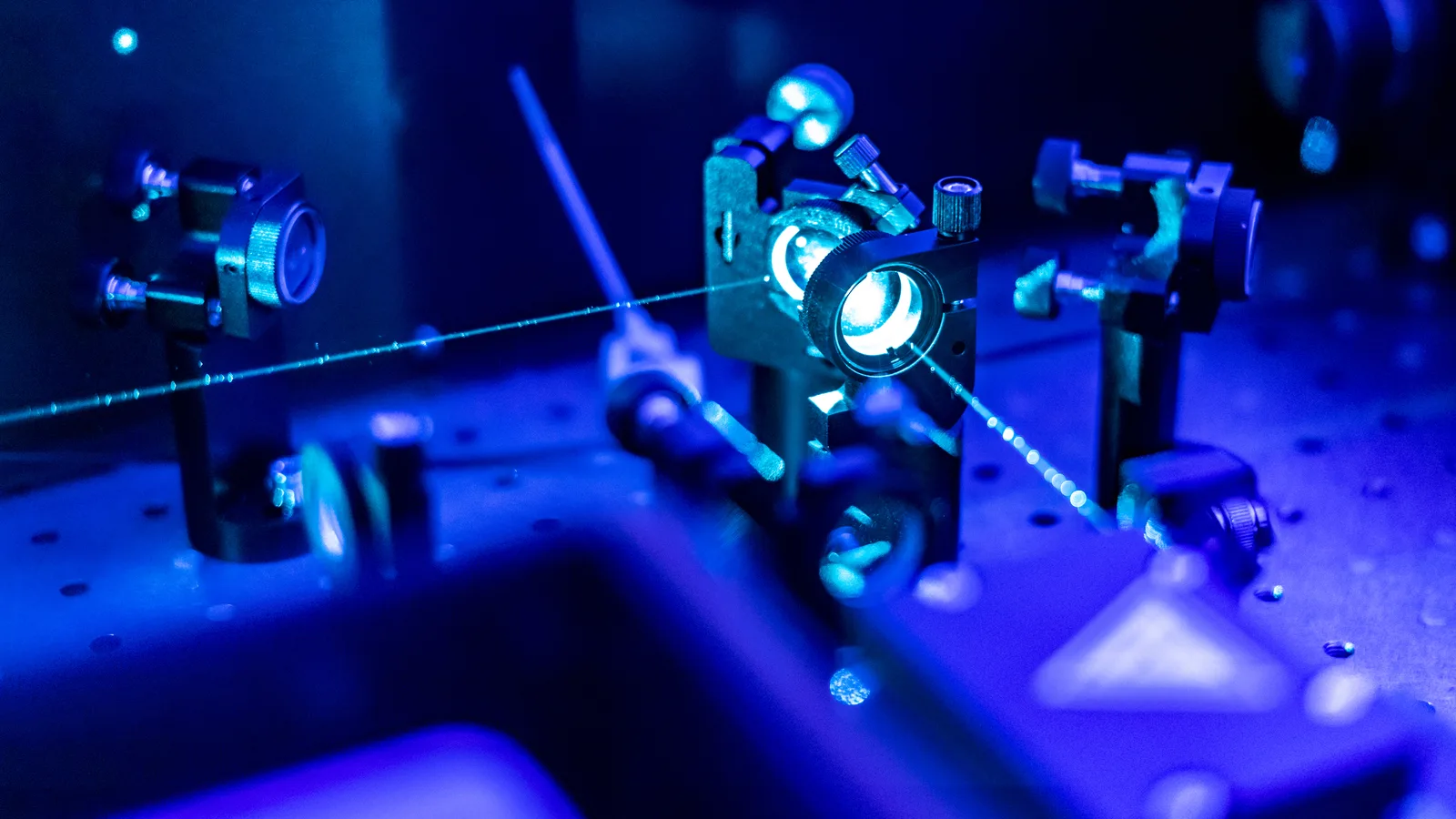
On the roof of Stony Brook University's Health Sciences Center, a laser fired particles of light out of a glass fiber thinner than a tenth of a human hair. Thirteen miles east, on top of the only building at Brookhaven National Laboratory with a clear line of sight back to Stony Brook, a detector caught them. No cable, no wire, nothing but open Suffolk County air in between.
That happened on Friday, August 21, and according to the two institutions' joint announcement, nothing like it had ever been done in the United States. The demonstration, sent from a rooftop facility Stony Brook calls the Quantum Watchtower to a receiving station Brookhaven calls the Quantum Lighthouse, is the first free-space optical link of its kind in the country, and it makes the airspace between Stony Brook and Upton part of the longest quantum network in America.
What actually flew across the county
The light being sent is not a message in any ordinary sense. Each transmission carries quantum states of light, pulses containing just a few individual photons, prepared so that their quantum properties encode information. In follow-up tests run at night, when background light is low, the team went further: they generated pairs of entangled photons in a Stony Brook physics lab, carried them by fiber up to the Watchtower, sent them across the open-air link, and successfully received and measured them at Brookhaven.
Entanglement is the property that makes a quantum network worth building. Two entangled photons remain linked no matter how far apart they travel, so measuring one instantly tells you about the other. That behavior is the foundation for communications that cannot be secretly intercepted, for new kinds of sensors, and eventually for quantum computers that work together across long distances.
The engineering problem is aim. The photons leave a fiber core about 5 microns across, cross 13 miles of moving air, and have to land in an equally small fiber on the far side. The adaptive optics that make that possible, lenses and mirrors that continuously correct for the atmosphere, were developed by a Brookhaven team of scientists, engineers and students, and the precision involved is the reason this had not been done here before.
Long Island already runs the nation's longest quantum network
The wireless hop is an extension of something many Long Islanders do not know is under their feet. Stony Brook and Brookhaven have spent years building a quantum network that now spans 161 miles of commercial fiber and connects eight nodes across Long Island and the New York metropolitan area, the longest such network in the country. Entangled photons already travel through it routinely.
Fiber has a limit, though. It only carries the telecom wavelengths it was built for, and the machines a quantum network ultimately wants to connect, quantum processors and atomic systems, prefer infrared wavelengths that standard fiber handles poorly. Sending photons through open air frees the network from that constraint. The director of Stony Brook's Quantum Institute, Eden Figueroa, who holds a joint appointment at Brookhaven, says the open-air approach points toward something fiber cannot do: linking atomic quantum systems to one another over long distances at the wavelengths those systems natively speak.
The August 21 event carried some ceremony to match the physics. The Department of Energy's Under Secretary for Science, Darío Gil, attended the daytime demonstration, and the ribbon he cut was doing real work: it physically blocked the Lighthouse's receiving aperture, and cutting it let the photons from Stony Brook reach the detector.
The next link points at Yale
The Watchtower and the Lighthouse are two corners of a planned triangle. A third facility is under development at Yale University in New Haven, which would tie a major quantum computing research hub into the Long Island network across the Sound. The federal Department of Energy has framed the work as a step toward a national ecosystem where quantum machines, supercomputers and artificial intelligence systems can be connected and used together.
For the two local institutions, the milestone is the visible tip of years of quiet buildout. The fiber network under Long Island was pioneered by Stony Brook and Brookhaven together, and the new rooftop facilities were designed, built and staffed by teams of local scientists, engineers and students on both campuses.
What it means for someone who lives here
Most of the technologies that will come out of this, unhackable communication channels, networked quantum computers, ultra-precise sensing, are years away, and none of them will announce themselves when they arrive. What is true right now is simpler: the country's longest quantum network runs under Long Island, its first wireless quantum link runs over it, and the two rooftops trading entangled photons at night are in Stony Brook and Upton, not in Silicon Valley or Geneva. The next time you drive past the Health Sciences Center tower on Nicolls Road, look at the roof. Some of the strangest physics being done in America starts right there, and it is aimed east.
Loading comments…