
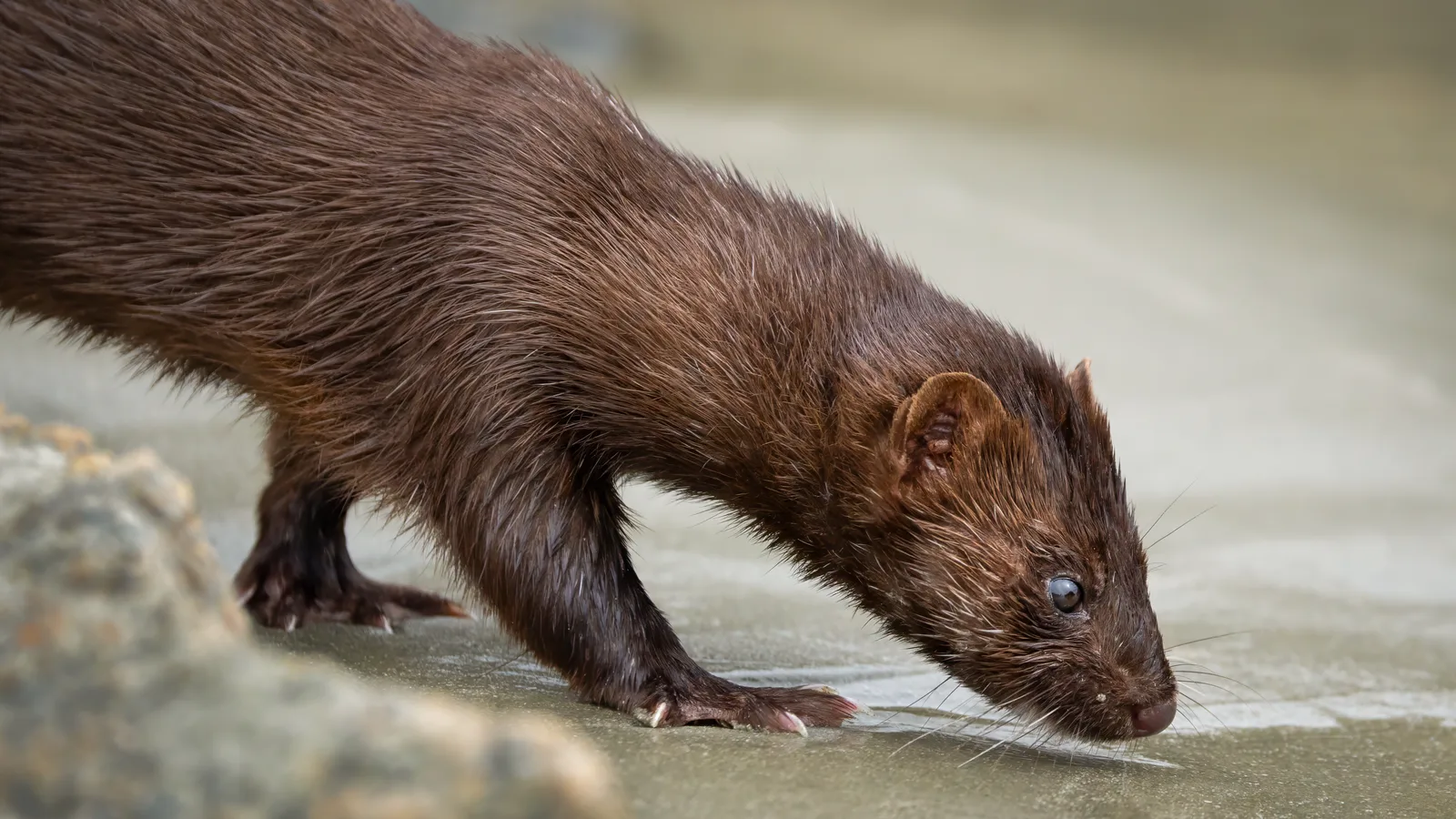
At 12:18 in the morning on August 4, a trail camera in Fort Salonga recorded a long, low, dark animal slipping through the frame with prey in its mouth. Five days later the photographs and an accompanying video went up on iNaturalist, the public wildlife database where records live or die by peer review. Six naturalists examined them and reached the same identification, and the record now carries the platform's highest confidence grade. It is an American mink, photographed alive on Long Island, and anyone can look at the evidence.
That sentence is bigger than it sounds. The mink sits on the official look-for list of the Long Island Mammal Survey, Seatuck Environmental Association's multi-year effort to map which wild mammals actually live here, precisely because its status on the Island has been listed as unknown. Naturalists have spent years pointing cameras at stream banks and marsh edges hoping for exactly this frame.
Two records on Long Island, ever, and both are from this year
iNaturalist has logged mink observations in Suffolk County 24 times since the platform launched in 2008. All but two of them come from Fishers Island, the strip of Suffolk that sits two miles off the Connecticut coast, a place that is Long Island on paper and New England in every biological sense. Nassau County has zero. On Long Island proper, the database holds exactly two records, and both were made in 2026, within a few miles of each other in Fort Salonga.
The first was a teaser. On February 9, a different trail camera on Crab Creek caught a single grainy nighttime still. The observer who posted it was upfront about not being sure what the animal was, and an expert reviewer noted the core problem: mink were not known to occur on Long Island outside Fishers Island, and one blurry photo could not rule out the lookalikes. The record eventually earned its confirmation, but it was the kind of evidence that persuades a specialist rather than settles a question.
The August capture settles it. Clear photographs, video, an animal carrying its catch, and a unanimous panel of identifiers. Whatever room for doubt February left, it is gone.
What exactly is a mink
The American mink is a member of the weasel family, a native North American predator about the length of a house cat but far slinkier, built for water. It hunts fish, crabs, frogs and small mammals along stream banks, pond edges and salt marsh, dens in root tangles and rock piles near the waterline, and does most of its work at night. That last habit matters here: an animal that swims, hunts in darkness and avoids open ground is exactly the kind of neighbor that could persist in small numbers for years without a single confirmed photograph.
Fort Salonga is plausible mink country. The hamlet's wooded ponds and creeks drain north into Long Island Sound between Northport Bay and Sunken Meadow, a corridor of fresh and salt water stitched together by exactly the kind of brushy edges the species works. That two independent cameras in the same corner of the Town of Huntington produced the Island's only two records suggests the animal, or animals, found what they needed there.
The people pointing the cameras
The August record was posted by an iNaturalist account called LI Nature Corps, a volunteer effort whose trail cameras have been feeding Long Island wildlife monitoring for years. In the observation's own comment thread, the account describes working with the Town of Huntington on reducing roadkill in the area, because the animals turning up under wheels lately include river otters, turtles and opossums.
That detail is the sober edge under the good news. Long Island's semi-aquatic wildlife has been quietly recovering for two decades. River otters, once written off here, have reestablished themselves and are now documented across the Island, a comeback tracked by Seatuck's own otter monitoring. The mammal survey itself exists to update a species map drawn in the early 1960s, on the theory that the Island's wildlife has changed more than its textbooks have. A mink on camera says the recovery may run one species deeper than anyone could prove. The roadkill count says the recovering animals and the Island's traffic are meeting at the same creek crossings.
What this means for a reader
It means that on a suburban island of nearly three million people, a native predator thought possibly gone has been living along the creeks the whole time, close enough to Northport that its portrait got taken between a pharmacy run and a school drop-off. The woods at the end of the cul-de-sac are wilder than they look.
It also means the next record might be yours. The Long Island Mammal Survey runs on volunteers and public sightings, and iNaturalist is free: a clear photo, even from a phone or a backyard camera, is how an unknown status becomes a mapped one. February's blurry maybe and August's unmistakable yes came off cameras somebody bothered to strap to a tree. Between them, they just rewrote a line in Long Island's natural history.
Loading comments…